
Historical reading · v220 · 2026-11-17. Read the current understanding and full revision history →
Historical reading v220 · 公开专题 · 中美关系与中国外交
U.S.–China & China's Diplomacy
The U.S.–China relationship and its friction points (tech, trade, Taiwan), set against Beijing's broader great-power and Global South diplomacy — summits, MFA statements, partnerships, and how China frames its global posture.
Historical reading v220 · v220 · 17 Nov
China stages trilateral summit with Russia and U.S. at APEC, hedging via Global South
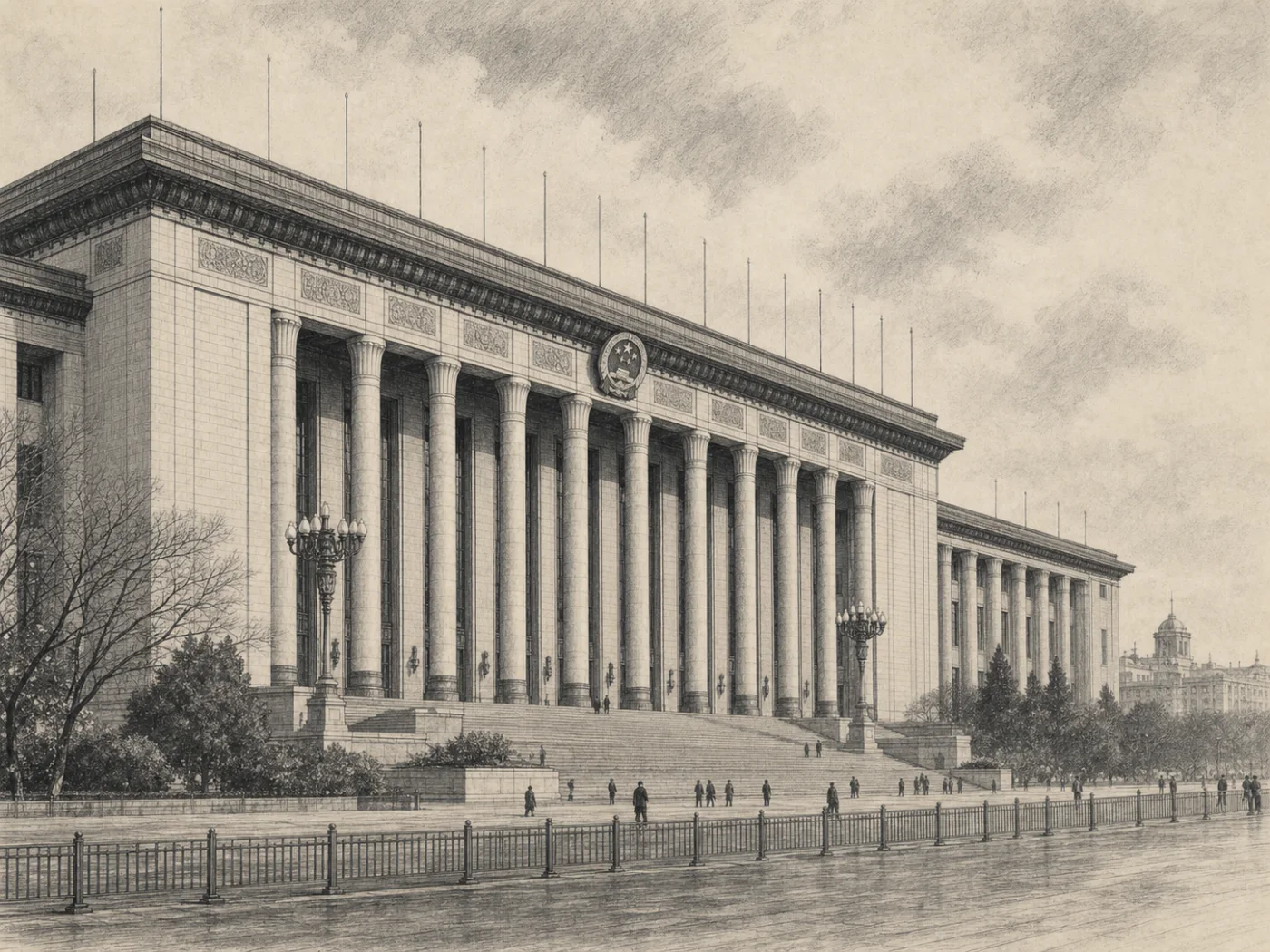
The U.S.–China relationship is being absorbed into a trilateral great-power summit that Beijing is hosting on the margins of APEC, a format that lets Xi Jinping manage Washington without a bilateral meeting that would invite demands on Taiwan or tech. MFA spokesperson Mao Ning confirmed on November 16 that the Chinese, Russian and American heads of state will meet face-to-face in Shenzhen for the first time in history, to exchange views on safeguarding world peace and promoting strategic stability among major powers 1. That is the period's defining move: it turns the previously unconfirmed Xi–Trump contact into a three-way stage that Beijing can present as responsible major-power management rather than a concession to Washington.
The trilateral framing is deliberate. Mao cast China, Russia and the U.S. as founding UN members and Security Council permanent members that once fought together in the anti-fascist war, and said stronger communication, dispute management and stable relations serve the three countries and international expectations 1. By anchoring the meeting in world peace and strategic stability, Beijing avoids appearing to seek U.S. approval and instead positions itself as a co-manager of global order alongside Moscow and Washington. This is a face-saving structure that also gives Xi a platform to project leadership without a bilateral summit that would put Taiwan or export controls on the table.
APEC remains the vehicle. Xi will chair the 33rd APEC Economic Leaders' Meeting in Shenzhen on November 18–19 under the theme "building an Asia-Pacific community, promoting common prosperity," with priorities of openness, innovation and cooperation 2. The official readout leans hard on openness as the sure path to prosperity—a pointed contrast to U.S. tech restrictions without naming them 2. A People's Daily feature on the 2026 Belt and Road media cooperation forum and the 12th ASEAN-plus-three media seminar reinforces the same line: open cooperation, shared development and people-to-people connectivity as the region's default 3. Embedding the trilateral meeting inside APEC gives Beijing agenda-setting power and a multilateral frame for any U.S. contact.
The trade track is still operating but has not advanced in the new documents. The prior signal remains the reference point: MOFCOM's He Yadong confirmed the "300-for-300" (300亿对300亿) reciprocal tariff-reduction framework is under close implementation communication, with eight rounds of consultations since May 2025 and China claiming full implementation of prior consensus 4. No new document closes that framework or reports a fresh round, so the economic channel is live but static while the political channel jumps to the summit level.
The tech fight is not resolved by the summit. The prior charge from Treasury Secretary Scott Bessent that a Chinese AI model was used in cyberattacks on French supermarket refrigeration systems still stands as Beijing's live grievance, and Chinese analysts continue to call it a politicization of cybersecurity meant to discredit Chinese technology 5. The trilateral agenda of strategic stability does not address export controls or AI evidence disputes, so the summit may stabilize the political atmosphere without touching the tech mechanism.
Beijing's hedge continues through party-to-party and Global South diplomacy. The fifth China-Arab States Political Parties Dialogue opened in Suzhou on November 13, co-hosted by the CPC International Department and the Jiangsu party committee, with over 100 leaders from 22 Arab countries, marking 70 years of China-Arab ties and 10 years of the mechanism 6. In parallel, MFA special envoys fanned out to seven countries in the Middle East, Gulf, Red Sea and Horn of Africa, with Mao framing the trips as implementing Xi's Middle East peace initiative and four principles on African hot spots 1. This is conflict-mediation diplomacy that builds Global South credentials independent of Washington.
Subnational corporate diplomacy keeps Western capital engaged. Shanghai Mayor Zhu Zhongming asked Coca-Cola CEO James Quincey to raise the standing of its Shanghai headquarters in the company's global layout and debut more global and limited products in the city first 7. Jiangsu Governor Liu Xiaotao met GE HealthCare's global imaging CEO and ArcelorMittal's Lakshmi Mittal, backing a new-energy soft magnetic materials project and expanded manufacturing and R&D 8. These channels run beneath the summit and signal that Beijing wants investment flowing even as it manages the U.S. politically.
What this adds up to: a trilateral summit that stabilizes great-power politics without resolving tech or trade, an APEC hosting role that amplifies Beijing's openness narrative, and a hedge built through Arab party dialogue, African and Middle East mediation, and CEO diplomacy. Watch whether the Shenzhen trilateral produces a concrete mechanism for U.S.–China military or tech talks, whether the APEC leaders' declaration delivers real trade and AI language, and whether the Bessent AI-cyberattack charge resurfaces to undercut the summit glow.
What changed in this reading
How the evidence changed
Comparing v219 with v220. Band width counts distinct cited documents.
Cited in both 8
- Senior executives from GE HealthCare and ArcelorMittal visit separately
- Fifth China-Arab States Political Parties Dialogue held in Suzhou
- Commerce Ministry: China and the US maintain close communication on tariff cuts, trade, investment and other issues
- Hoping to further elevate Shanghai's headquarters status: Zhu Zhongming meets Coca-Cola CEO James Quincey
- President Xi Jinping leads the Asia-Pacific family forward
- US uses French supermarket cyberattacks to smear Chinese AI, fueling broader tech containment push: analyst
- Deepening Exchanges and Cooperation for Mutual Benefit
- Leaders of China, Russia, and the US meet face-to-face for the first time in history
Newly cited 0
No longer cited 0
Evidence behind this reading
| # | Document | Publisher | Published |
|---|---|---|---|
| 01 | Leaders of China, Russia, and the US meet face-to-face for the first time in history | story_resolution | 2026-11-16 |
| 02 | President Xi Jinping leads the Asia-Pacific family forward | MOT | · |
| 03 | Deepening Exchanges and Cooperation for Mutual Benefit | People's Daily | 2026-11-15 |
| 04 | Commerce Ministry: China and the US maintain close communication on tariff cuts, trade, investment and other issues | Qiushi | 2026-11-12 |
| 05 | US uses French supermarket cyberattacks to smear Chinese AI, fueling broader tech containment push: analyst | Global Times | 2026-11-13 |
| 06 | Fifth China-Arab States Political Parties Dialogue held in Suzhou | Jiangsu Provincial Government | 2026-11-14 |
| 07 | Hoping to further elevate Shanghai's headquarters status: Zhu Zhongming meets Coca-Cola CEO James Quincey | Shanghai Municipal Government | 2026-11-14 |
| 08 | Senior executives from GE HealthCare and ArcelorMittal visit separately | Jiangsu Provincial Government | 2026-11-14 |
China Snapshot Limited (Hong Kong). Chinese sources machine-translated by DeepSeek; interpretation drafted by a language model under our editorial standards; corrections to support@china-snapshot.com.