
Historical reading · v192 · 2026-10-16. Read the current understanding and full revision history →
Historical reading v192 · 公开专题 · 贸易与出口
Trade & Exports
China's foreign trade — exports, imports, tariffs, the trade balance, and bilateral/multilateral trade agreements.
Historical reading v192 · v192 · 16 Oct
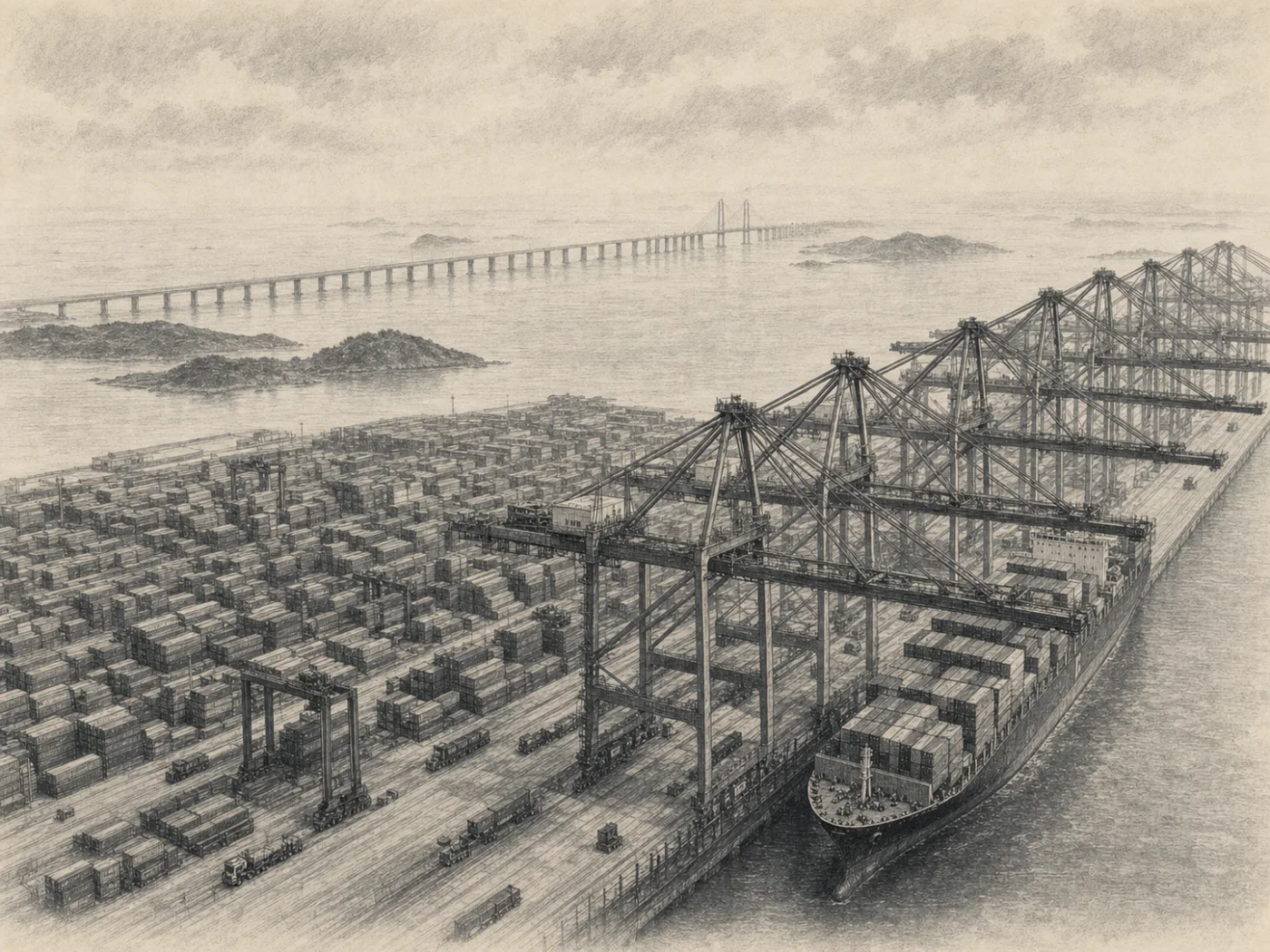
China caps hybrid-car exports to EU; export controls widen
The centre of gravity in China's trade policy has moved one step further: Beijing is now managing export volumes, not only export technology. The clearest new evidence is a China-EU compromise in which China agreed to limit hybrid-vehicle exports to Europe in return for the EU holding back — an explicit, negotiated restraint on a flagship Chinese export category 1. That is a qualitative shift from the toolkit of the past year, which was dominated by retaliatory import remedies (the EU p-nitrotoluene anti-dumping case) and technology-export registration.
Three instruments now run in parallel on the export side. First, technology controls: the 16 October MOFCOM/MOST consultation on adding 40 technologies to the Catalogue of Technologies Prohibited and Restricted from Export — 23 in AI, 5 in biomedicine, 12 in solar PV — with immediate pre-export registration 2. Second, negotiated volume restraint on vehicles, via the EU understanding 1. Third, the standing licensing architecture: the 2027 auto and motorcycle export-licence regime requiring proof of overseas after-sales networks 3, and the precursor-chemicals catalogue routing US, Mexican, Canadian, Myanmar, Lao and Afghan buyers through licensing 4. The design is surgical — public-domain AI is exempted, non-ownership-transferring biomedicine licensing is facilitated, and PV coverage extends to the key and core equipment that embodies the technology 2.
The EU deal carries the analytical weight because of how Beijing framed it. Mao Ning called the second meeting of the China-EU trade and investment consultation mechanism "positive progress" and urged the EU to uphold free-trade commitments and WTO rules and avoid protectionism 1. That is defensive framing: the restraint is presented as a concession extracted under pressure, not as a voluntary opening, and the warning signals Beijing expects more demands.
That restraint is not a settlement. The same press conference reports the EU is preparing new trade instruments to shrink its China deficit 1, so the hybrid commitment buys time rather than peace. A second counter-signal: at the recent leaders' meeting Trump reportedly asked China to open dialogue with Japan's Prime Minister Takaichi and to cancel export controls against Japan 5, implying live Chinese controls on Japan exports and US mediation over them. Neither detail is confirmed by MOFCOM, but both show the export-control leg is contested rather than settled.
The underlying goods figures are unchanged. SAFE's second-quarter balance of payments shows a goods surplus of $278.8bn and a current account surplus of $193.7bn, with H1 current account at $378.0bn 6; August's goods surplus was $116.3bn against a services deficit of only $21.8bn 7. The offset remains a capital and financial account deficit — $157.1bn in Q2 and $345.2bn in H1 — meaning China runs the surplus and lends the proceeds abroad 6. Newly released external-debt data sharpen that picture: $2.4982tn at end-June, 59% of it short-term, with trade-related credit equal to 41% of short-term debt 8. The exposure sits in short-term, trade-financed liabilities, not in long-dated sovereign borrowing.
The diversification playbook continues in parallel. The 140th Canton Fair opens on its 70th anniversary with 32,000 exhibitors, over 11,000 of them "specialized, refined, differentiated, innovative" (专精特新) firms or single-product champions, and the 9th CIIE opens 5 November with free booths for least-developed countries and an upgraded Asia-Africa zone to capture zero-tariff benefits 9. On the domestic mirror side, NFRA and MOFCOM's Jin Fa No. 17 pushes domestic trade credit insurance to support integration of domestic and foreign trade (内外贸一体化) 10: the same firms China wants exporting are being insured on the domestic leg, a hedge against external demand shocks.
Two limits bound the reading. The technology catalogue remains a consultation document — comments run 16 October to 15 November 2026 — and it is unresolved whether PV equipment exports, which underpin much Belt-and-Road solar build-out, survive the final list 2. And the EU hybrid restraint exists as a reported understanding, not a published instrument, so its scope, duration and enforcement are unknown. The tests now are whether the restraint is written down, whether the revised catalogue is finalised after 15 November and how deep it reaches into equipment, and whether MOFCOM's remedy filings stay confined to p-nitrotoluene.
What changed in this reading
A new instrument class appeared: a negotiated export restraint, with China agreeing to limit hybrid-vehicle exports to the EU while the EU prepares fresh trade tools against its China deficit 1. Beijing also faces US pressure reportedly asking it to lift export controls on Japan 5. Newly released external-debt data ($2.4982tn, 59% short-term) and a domestic trade-insurance push round out the picture 8,10.
How the evidence changed
Comparing v191 with v192. Band width counts distinct cited documents.
Cited in both 6
- Announcement by the Ministry of Commerce and Four Other Departments on Adjusting the Catalog for the Administration of Precursor Chemicals Exported to Specific Countries (Regions)
- Notice of the General Office of the Ministry of Commerce on the Application Work for 2027 Automobile and Motorcycle Export Licenses
- SAFE Releases China's Balance of Payments Goods and Services Trade Data for August 2026
- SAFE Releases China's Balance of Payments for the Second Quarter and First Half of 2026
- Foreign Ministry Spokesperson Mao Ning Hosts Regular Press Conference on October 14, 2026
- Ministry of Commerce and Ministry of Science and Technology Announcement No. 48 of 2026: Public Comments Sought on Revising the Catalogue of Technologies Prohibited and Restricted from Export and Interim Registration Administration Imposed on Exports of Relevant Technologies
Newly cited 4
- Notice of the National Financial Regulatory Administration and the Ministry of Commerce on Strengthening Commerce-Insurance Coordination to Improve Domestic Trade Insurance
- SAFE Releases China's Full-Scale External Debt Data at End-June 2026
- Foreign Ministry Spokesperson Mao Ning Hosts Regular Press Conference on October 8, 2026
- October 16, 2026: Foreign Ministry Spokesperson Mao Ning Hosts Regular Press Conference
No longer cited 4
- Foreign Ministry Spokesperson Guo Jiakun's Remarks on October 3, 2026
- China's Balance of Payments Report for the First Half of 2026
- MOFCOM Announcement No. 44 of 2026: Anti-dumping investigation launched into imports of p-nitrotoluene originating in the EU
- Decision on Taking Countermeasures Against Fonseca, Minister of Foreign Affairs, Foreign Trade, Education, Culture, Science and Technology of Belize (2026-10-12)
Evidence behind this reading
China Snapshot, a publication of CHINA SNAPSHOT LIMITED (Hong Kong). Operated by Tristan McInnis, Managing Partner, Inner Chapter, Shanghai. Chinese sources machine-translated by DeepSeek; interpretation drafted by a language model under our editorial standards; corrections to support@china-snapshot.com.