
Historical reading · v185 · 2026-10-04. Read the current understanding and full revision history →
Historical reading v185 · 公开专题 · 贸易与出口
Trade & Exports
China's foreign trade — exports, imports, tariffs, the trade balance, and bilateral/multilateral trade agreements.
Historical reading v185 · v185 · 4 Oct
Trade surplus at record pace; surplus recycled abroad
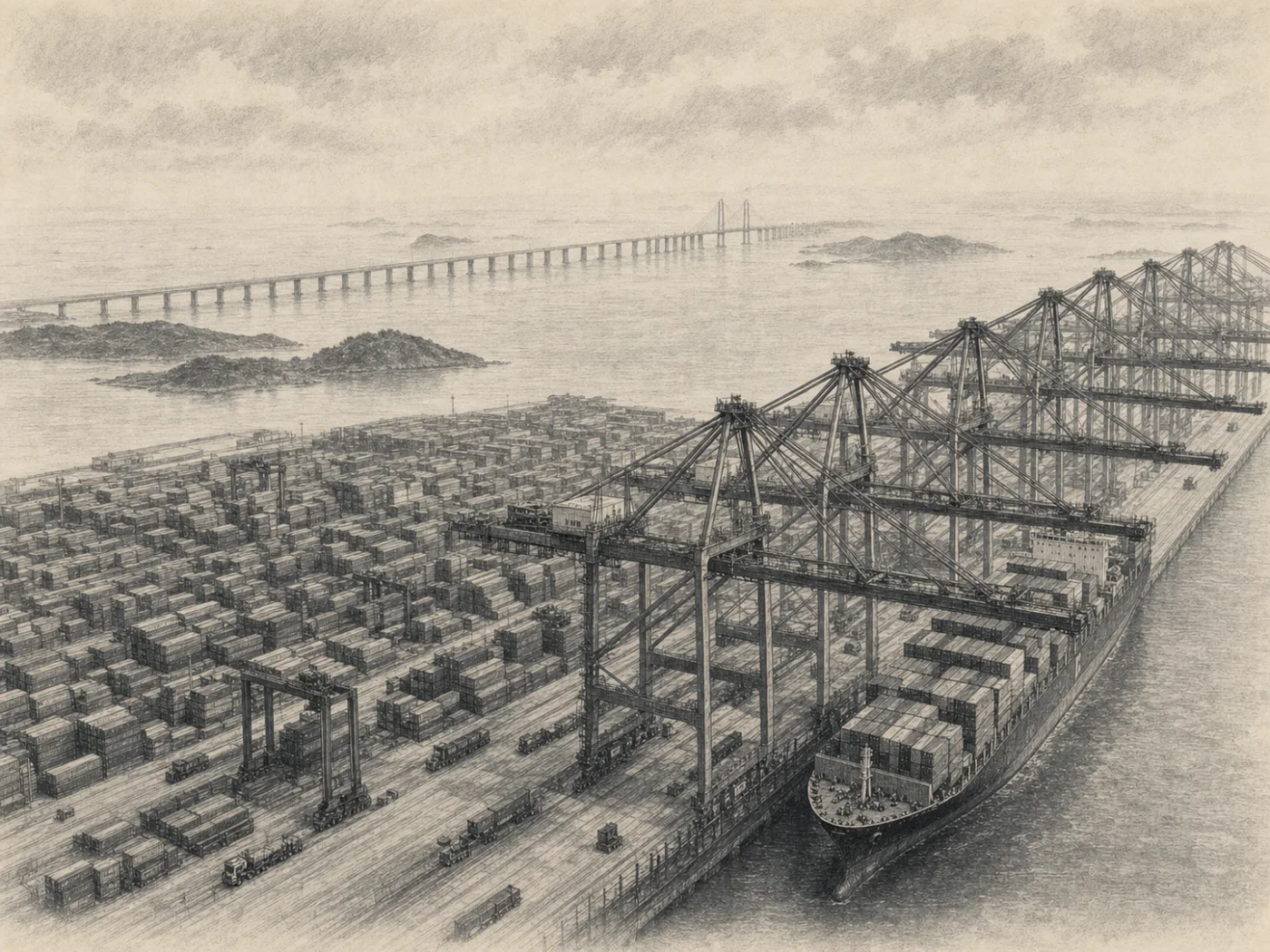
The hard numbers have landed, and they confirm China's export machine is running at a scale that dwarfs any diversification narrative. SAFE's second-quarter balance of payments shows a goods trade surplus of $278.8bn in the quarter alone, and August's monthly goods surplus was $116.3bn, leaving the current account in surplus to the tune of $378.0bn for the first half of 2026 1,2. This matters because a surplus this large is exactly what feeds foreign "overcapacity" charges, tariff exposure and anti-dumping risk — the friction tracks the standing brief was already monitoring.
The mechanism is narrow: goods carry everything, and services barely dent it. In August, goods exports of $388.1bn against imports of $271.9bn produced the $116.3bn goods surplus, while services ran only a $21.8bn deficit; travel (173.1bn yuan), transport (153.2bn yuan) and other commercial services (143.7bn yuan) are the big service lines, but they are an order of magnitude smaller than the goods gap 2. The composition means the surplus is manufactured-goods volume, not tourism or cyclical service noise.
The surplus is being sent back out the door. SAFE books a capital and financial account deficit of $157.1bn in Q2 and $345.2bn in H1, closely matching the current account surpluses of $193.7bn and $378.0bn 1. That is net lending to the rest of the world, not a weakening trade position: China runs the surplus and exports the proceeds through the financial account. Reading the trade story without that offset overstates both the external strength and the domestic stimulus it delivers.
The external balance sheet is de-risked. Full-scale external debt at end-June 2026 was 170.1trn... — precisely 170,148bn yuan, or $2.498trn — of which 59% was short-term, but 41% of that short-term stock is trade-related credit, i.e. routine export financing, and 56% of the total is local-currency denominated, with debt securities at 27% and intercompany lending at 12% 3. A short-term-heavy, majority-renminbi, trade-linked debt profile is far less fragile than the headline ratio suggests.
What this cycle does not supply is new tariff or partner-pushback detail; the governance tracks from the standing brief are unchanged and remain the policy response to the surge. MOFCOM's 2027 auto and motorcycle export-licence regime still requires proof of overseas after-sales and repair networks, with false filings risking suspension or revocation 4; domestic trade credit insurance (内贸险) under Jin Fa No. 17 still channels exporters toward the home market 5; and the precursor-chemicals licensing catalogue still targets US, Mexican and Canadian buyers 6. The BOP data is the reality these instruments are managing — the surplus is being governed, not capped.
The venue platform keeps thickening ahead of the November APEC leaders' meeting in Shenzhen. Beijing is running 2026 as "APEC China Year" and has confirmed it welcomes Putin to the summit 7; Li Qiang opened the 5th Global Digital Trade Expo in Hangzhou pitching open-source AI and freer, better-governed digital trade to some 1,200 delegates from nearly 50 countries 8; and the National Energy Administration met Singapore's trade-and-industry minister on APEC energy cooperation and power interconnection 9. These are stages for the trade narrative, not deliverables on access or tariffs.
Net: the surplus is running at a pace that keeps China the target of trade-remedy action while its capital account recycles the proceeds abroad, and the policy architecture — export licensing, domestic absorption, multilateral venue-building — is intact. Watch four things: whether the surplus pace triggers fresh anti-dumping or countervailing-duty filings this quarter; what the full 2026 H1 BOP Report tables show about whether the capital outflow is portfolio or direct investment 10; whether APEC Shenzhen produces any signed trade deliverable; and whether the auto and motorcycle licence regime actually filters 2027 export volumes.
What changed in this reading
New hard data replaces the prior brief's data vacuum: SAFE reports a Q2 goods surplus of $278.8bn and an August monthly goods surplus of $116.3bn, with a $378.0bn H1 current account surplus offset by a $345.2bn capital and financial account deficit 1,2, plus full external-debt data at end-June (170,148bn yuan, 59% short-term, 56% local-currency) 3. This quantifies the export surge the earlier brief could only describe qualitatively.
How the evidence changed
Comparing v184 with v185. Band width counts distinct cited documents.
Cited in both 5
- Announcement by the Ministry of Commerce and Four Other Departments on Adjusting the Catalog for the Administration of Precursor Chemicals Exported to Specific Countries (Regions)
- Foreign Ministry Spokesperson Guo Jiakun Chairs a Regular Press Conference on September 24, 2026
- Notice of the National Financial Regulatory Administration and the Ministry of Commerce on Strengthening Commerce-Insurance Coordination to Improve Domestic Trade Insurance
- Notice of the General Office of the Ministry of Commerce on the Application Work for 2027 Automobile and Motorcycle Export Licenses
- Foreign Ministry Spokesperson Guo Jiakun's Remarks on October 3, 2026
Newly cited 5
- Head of the National Energy Administration Meets with Singapore's Senior Minister of State for Foreign Affairs and Trade and Industry
- SAFE Releases China's Balance of Payments Goods and Services Trade Data for August 2026
- SAFE Releases China's Full-Scale External Debt Data at End-June 2026
- China's Balance of Payments Report for the First Half of 2026
- SAFE Releases China's Balance of Payments for the Second Quarter and First Half of 2026
No longer cited 6
- Request for Comments on Significant Foreign Trade Barriers for the 2027 National Trade Estimate Report
- Liaoning Investment and Trade Fair Consumption Promotion Month kicks off
- China-ASEAN expo to highlight FTA 3.0 opportunities
- PJSC Aeroflot, 1 Arbat St., 119019, Moscow, Russia; Order Renewing Temporary Denial of Export Privileges
- Foreign Ministry Spokesperson Guo Jiakun Hosts Regular Press Conference on September 21, 2026
- Full transcript of the September regular press conference
Evidence behind this reading
China Snapshot, a publication of CHINA SNAPSHOT LIMITED (Hong Kong). Operated by Tristan McInnis, Managing Partner, Inner Chapter, Shanghai. Chinese sources machine-translated by DeepSeek; interpretation drafted by a language model under our editorial standards; corrections to support@china-snapshot.com.