
Historical reading · v178 · 2026-09-17. Read the current understanding and full revision history →
Historical reading v178 · 公开专题 · 贸易与出口
Trade & Exports
China's foreign trade — exports, imports, tariffs, the trade balance, and bilateral/multilateral trade agreements.
Historical reading v178 · v178 · 17 Sep
China's export pivot to ASEAN gets a CAFTA 3.0 rules framework
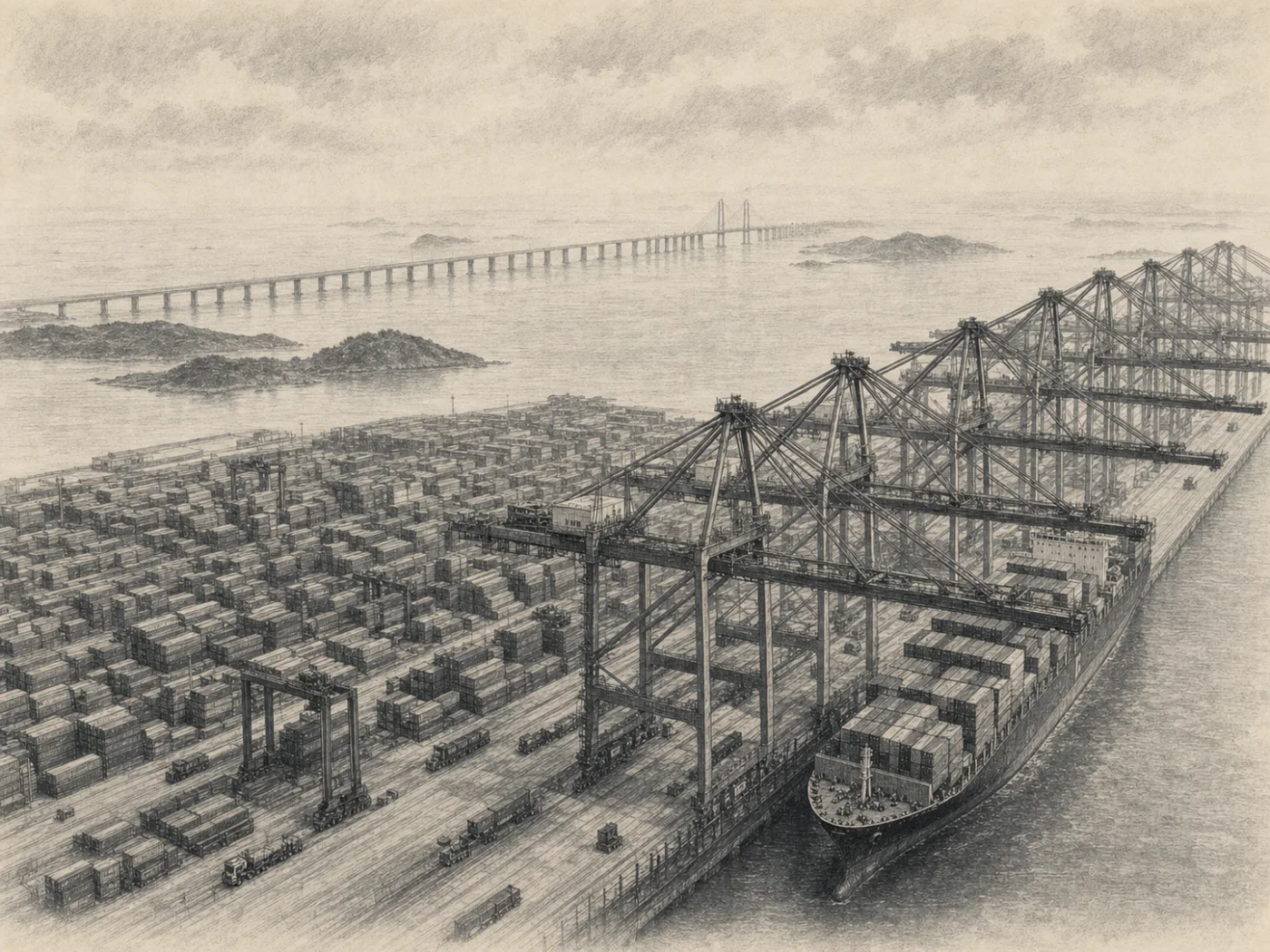
China's goods surplus and the rotation of its trade map toward Asia remain intact, and this cycle the institutional scaffolding around that pivot finally came into view: the 23rd China-ASEAN Expo opened in Nanning under the CAFTA 3.0 banner, and the Beijing services fair closed with a pledge of high-standard opening 1,2. The judgment is unchanged — goods momentum is strong, the United States is the shrinking destination, and Beijing is now writing the rules for the markets it is winning. This matters because Beijing is converting a passive flow of diverted exports into a negotiated framework that lowers its exposure to US tariff machinery.
The sharpest new signal is that ASEAN is being upgraded from a buyer of Chinese goods into a rules-based trading bloc. The 23rd China-ASEAN Expo runs 17-21 September in Nanning, Guangxi, covering roughly 170,000 square metres with more than 3,400 companies from over 70 countries under the theme "CAFTA 3.0 Opportunities, Better Life," and it deliberately headlines digital communications, green development and other new-economy sectors 1. ASEAN already sits atop the provincial partner tables; the expo is where the next phase — services, digital and green trade — gets packaged for regional buyers rather than left as raw export flows.
The services channel is being pushed in parallel. The China International Fair for Trade in Services (CIFTIS), held in Beijing 9-13 September, closed after nearly 100 conferences and forums and more than 100 matchmaking events, with MOFCOM's Zhu Guangyao framing it as a signal that China will "unswervingly expand high-standard opening up" 2. Services and digital trade are precisely the categories where Beijing faces less of the overcapacity and anti-dumping friction that follows manufactured goods, so the fair is a deliberate attempt to shift the export story toward less contested terrain.
Those new fronts sit on an unchanged hard core. SAFE's August read showed $1.5 trillion in cross-border receipts and payments by non-bank entities, a net inflow of $62.4 billion, up 4% month-on-month, with goods trade the leading net-inflow channel; the services deficit widened 6% on summer study-abroad and travel, FDI dividend and profit remittances fell 23%, and the corporate FX settlement ratio was 61.5%, 2.7 points below the January-July average 3. The supply side still runs hot in exactly the targeted sectors: August industrial value added rose 5.2%, with equipment manufacturing up 12.1%, high-tech manufacturing up 16.7% and electronics up 17.2%, while lithium-ion battery output jumped 57.2% and industrial robots 34.6% — output that must find foreign buyers 4.
Liaoning remains the cleanest measured proof that diversification converts into numbers. January-August trade hit a same-period record 527.4 billion yuan, up 5.1%, with exports up 13.4%; ASEAN stayed the top partner at 97.2 billion yuan, up 19.1%, the EU was second at 84.49 billion, up 8.5%, Latin America rose 14.5%, Africa 83.8% and the five Central Asian states 91% 5. Processing trade climbed 36.5% to 131.09 billion yuan, lifting its share 5.7 points to 24.9% — the integration Beijing wants and the exposure Washington can reach remain the same channel.
Washington's remedy machinery kept grinding on cadence, not as a shock: a preliminary affirmative countervailing-duty determination on tin mill products from China with a critical-circumstances finding opening retroactive duties 6, and final results plus partial rescission of the 2023-2024 steel-rack review 7, with USTR's 2027 National Trade Estimate comment request the pipeline that historically feeds new Section 301 actions 8. The counter-signal is that the export-control docket stretches well beyond China trade — the same week saw a renewed temporary denial of export privileges for Russia's PJSC Aeroflot 9 — while domestically Liaoning ran a consumption-promotion month across 25,000 merchants to soak up demand at home 10.
The implication for buyers of Chinese goods is that the ASEAN channel is becoming institutionalized faster than the US channel is closing, but the same overcapacity dynamic — strategic sectors running at double-digit growth — will keep generating partner pushback and anti-dumping actions, and Beijing knows it. Watch whether the CAFTA 3.0 upgrade moves from expo theme to signed protocol, and whether the services and green-trade push absorbs enough volume to keep the surplus from becoming a political liability in the very markets China is courting.
What changed in this reading
New documentation shifts the diversification thesis from data to institutions: the 23rd China-ASEAN Expo opened in Nanning under the CAFTA 3.0 framework with 3,400+ exhibitors from 70+ countries 1, and CIFTIS closed with a high-standard-opening pledge emphasizing services trade 2. Liaoning also launched a consumption-promotion month 10, and a renewed Aeroflot export-privilege denial shows the US export-control docket is not China-specific 9.
How the evidence changed
Comparing v177 with v178. Band width counts distinct cited documents.
Cited in both 6
- Request for Comments on Significant Foreign Trade Barriers for the 2027 National Trade Estimate Report
- Province's Foreign Trade Hits Record High for Same Period in First Eight Months
- Value added of industrial enterprises above designated size up 5.2% in August 2026
- Tin Mill Products From the People's Republic of China: Preliminary Affirmative Countervailing Duty Determination, Preliminary Affirmative Critical Circumstances Determination, and Alignment of Final Determination With Final Antidumping Duty Determination
- Certain Steel Racks and Parts Thereof From the People's Republic of China: Final Results and Rescission, in Part, of Antidumping Duty Administrative Review; 2023-2024
- SAFE Deputy Administrator and Spokesperson Li Bin Answers Questions from Reporters on the Foreign Exchange Market Situation in August 2026
Newly cited 4
No longer cited 6
- Ministry of Commerce Announcement No. 37 of 2026: Preliminary Ruling on Anti-Dumping Investigation of Imported Dichlorosilane Originating from Japan
- Ministry of Commerce Announcement No. 38 of 2026: Decision Announced to Extend the Anti-Dumping Investigation on Imported Pecans Originating in Mexico and the United States
- Glycine From India: Preliminary Results and Rescission, in Part, of Countervailing Duty Administrative Review; 2024
- National economy stable in August, with development trending toward new and better
- Transcript of the State Council Taiwan Affairs Office Press Conference (2026-09-16)
- Head of the National Energy Administration Meets with Singapore's Senior Minister of State for Foreign Affairs and Trade and Industry
Evidence behind this reading
China Snapshot, a publication of CHINA SNAPSHOT LIMITED (Hong Kong). Operated by Tristan McInnis, Managing Partner, Inner Chapter, Shanghai. Chinese sources machine-translated by DeepSeek; interpretation drafted by a language model under our editorial standards; corrections to support@china-snapshot.com.