
Historical reading · v165 · 2026-09-01. Read the current understanding and full revision history →
Historical reading v165 · 公开专题 · 贸易与出口
Trade & Exports
China's foreign trade — exports, imports, tariffs, the trade balance, and bilateral/multilateral trade agreements.
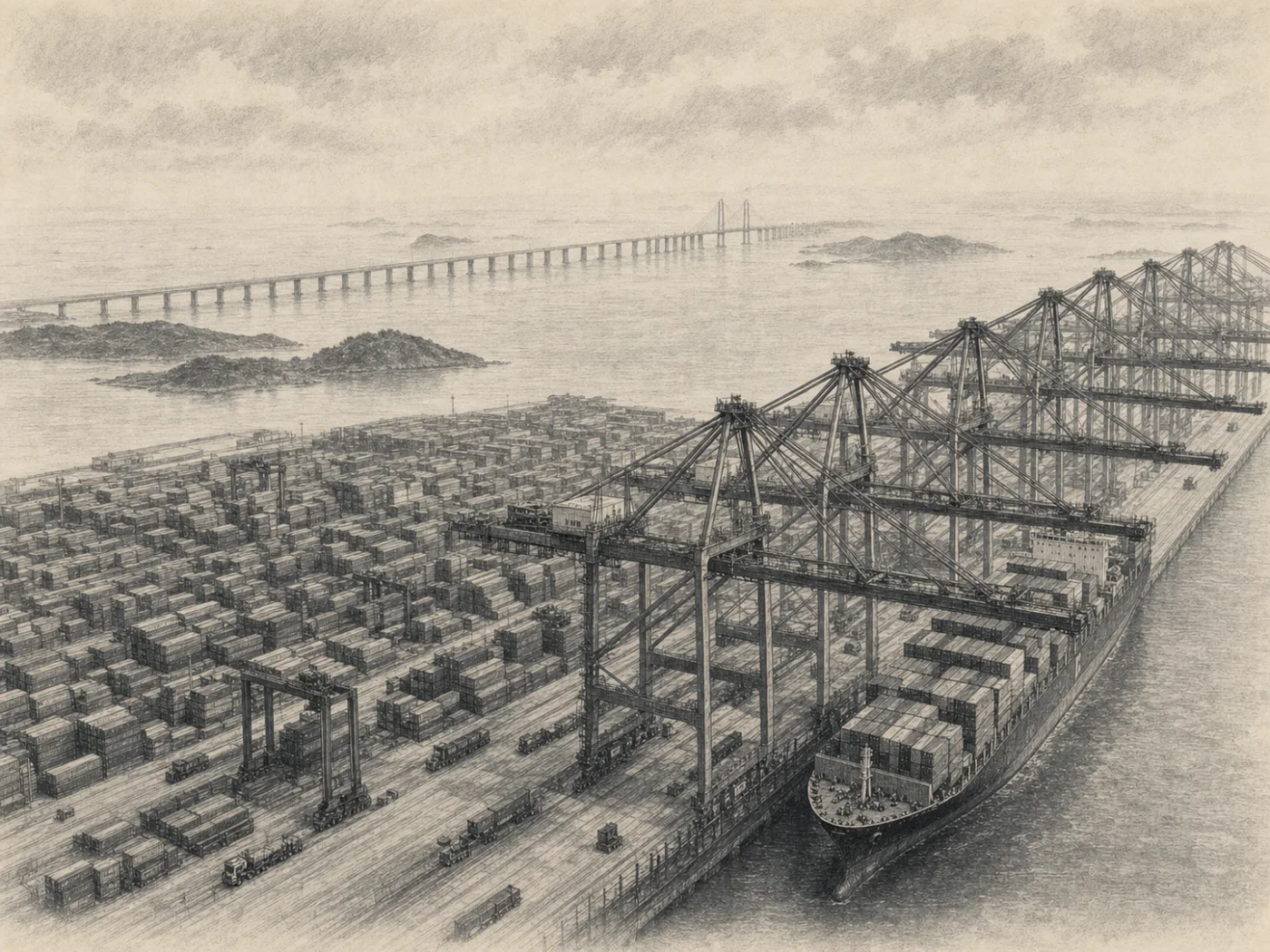
Historical reading v165 · v165 · 1 Sep
China shifts from export volume to managed trade as price-war discipline and Central Asia rail push take shape
China’s export engine is still running hot, but the newest evidence shows Beijing shifting from volume growth to managed trade: it is telling carmakers to keep the domestic price war out of export markets 1 and accelerating a physical trade corridor through Central Asia. The shift matters because it acknowledges that export success itself is now generating trade-remedy risk, and that non-US diversification needs real infrastructure, not just policy slogans.
The SCO trade anchor remains: Beijing says trade with other SCO members hit 8% of total foreign trade in 2025, rising from $12.1 billion in 2001 to $523.5 billion, according to MOFCOM spokesperson Huang Ling 2. Now the connectivity is catching up: Chinese builders are working on the China-Kyrgyzstan-Uzbekistan Railway tunnel in Jalal-Abad, Kyrgyzstan, and Air China launched direct Beijing-Bishkek flights on July 17 with three weekly round trips, part of a multimodal overhaul of the corridor 3. This is the layer that turns the SCO numbers into physical trade flows.
Sub-national trade diplomacy is thickening the same web. Liaoning's third export fair in Ulaanbaatar drew 89 companies and closed a $4 million steel-structure order for Zhongwei Group 4. The 30th Shandong-Taiwan economic and trade fair opened in Weifang on August 31, with mainland and Taiwan officials pushing industrial integration 5. These matchmaking events are the granular mechanism behind the diversification strategy.
The biggest new signal, however, is defensive. Bloomberg reports that China has instructed carmakers to keep the domestic price war away from export markets 1. That is an official admission that the brutal price competition in China's auto market—itself a product of overcapacity—could spill into exports and trigger anti-dumping actions. It also means Beijing is now actively managing export pricing as a trade-policy tool, not just letting companies compete freely.
The trade-remedy machinery is still tightening regardless. On September 1 the US Federal Register published final results of an expedited third sunset review keeping the antidumping order on certain steel grating from China in place 6, initiated a new round of five-year sunset reviews 7, and opened the opportunity for administrative review requests on other orders 8. Washington's legal process continues to grind, independent of Beijing's pricing discipline.
The other constraints haven't changed. Manufacturing PMI rose to 49.8 in August, but small firms and employment are still weak, and a MOFCOM plan to boost commodity consumption targets 60 trillion yuan in retail sales by 2030—a domestic fix that won't quickly lift import demand. The fifth Global Digital Trade Expo in Hangzhou (September 23–27) remains the test of whether digital services can become a real export category 9.
Outlook: expect export volumes to stay high and the surplus large, but watch three things—whether Beijing's car-export price discipline holds as domestic demand stalls; whether the G20 communiqué singles out China's surplus; and whether the Kyrgyzstan railway, once completed, measurably shifts China-Central Asia trade flows.
What changed in this reading
New documents add two elements not in the prior brief: Beijing is reportedly instructing carmakers to keep the domestic price war away from export markets (Bloomberg, 1), and the China-Kyrgyzstan-Uzbekistan railway plus new Beijing-Bishkek flights show the Central Asia corridor physically accelerating 3. The rest of the batch re-confirms the SCO trade share (8%) and the US steel-grating sunset review already in the standing brief.
How the evidence changed
Comparing v164 with v165. Band width counts distinct cited documents.
Cited in both 5
- Global Digital Trade Expo to open on Sept 23
- Third Liaoning Export Commodities Exhibition Held in Mongolia
- 30th Shandong-Taiwan Economic and Trade Fair Opening Ceremony and Cross-Strait Industrial Integration High-Quality Development Conference Held
- China's trade with other SCO member states accounts for 8% of its total foreign trade volume.
- Certain Steel Grating From the People's Republic of China: Final Results of the Expedited Third Sunset Review of the Antidumping Duty Order
Newly cited 4
- Initiation of Five-Year (Sunset) Reviews
- Antidumping or Countervailing Duty Order, Finding, or Suspended Investigation; Opportunity To Request Administrative Review and Join Annual Inquiry Service List; Note Regarding Format of Review Requests
- Expanded links supercharge trade
- China Tells Carmakers to Keep Price War Away From Export Markets
No longer cited 11
- August 2026 China Purchasing Managers' Index Performance
- High value-added products become main driver of export growth
- Articulated CNG Buses Exported to Colombia
- Zhejiang's trade with other SCO members hits record high in Jan-July
- Bessent to Push G20 to Rethink China Trade Terms, Reuters Says
- Foreign Ministry Spokesperson Guo Jiakun Holds Regular Press Conference on August 31, 2026
- China's trade promotion body steps up SCO business cooperation
- Macau Trade, Tourism and Investment Promotion Conference successfully held in Singapore, facilitating 74 signed projects
- Implementation Opinions of the Ministry of Commerce and Six Other Departments on Promoting the Expansion and Upgrading of Commodity Consumption
- Polyethylene Retail Carrier Bags From China, Indonesia, Malaysia, Taiwan, Thailand, and Vietnam; Institution of Five-Year Reviews
- Certain Alkyl Phosphate Esters From the People's Republic of China: Initiation of Circumvention Inquiry on the Antidumping and Countervailing Duty Orders
Evidence behind this reading
China Snapshot, a publication of CHINA SNAPSHOT LIMITED (Hong Kong). Operated by Tristan McInnis, Managing Partner, Inner Chapter, Shanghai. Chinese sources machine-translated by DeepSeek; interpretation drafted by a language model under our editorial standards; corrections to support@china-snapshot.com.