
Historical reading · v148 · 2026-08-27. Read the current understanding and full revision history →
Historical reading v148 · 公开专题 · 贸易与出口
Trade & Exports
China's foreign trade — exports, imports, tariffs, the trade balance, and bilateral/multilateral trade agreements.
Historical reading v148 · v148 · 27 Aug
China institutionalizes alternative trade routes as US tariff threat lingers
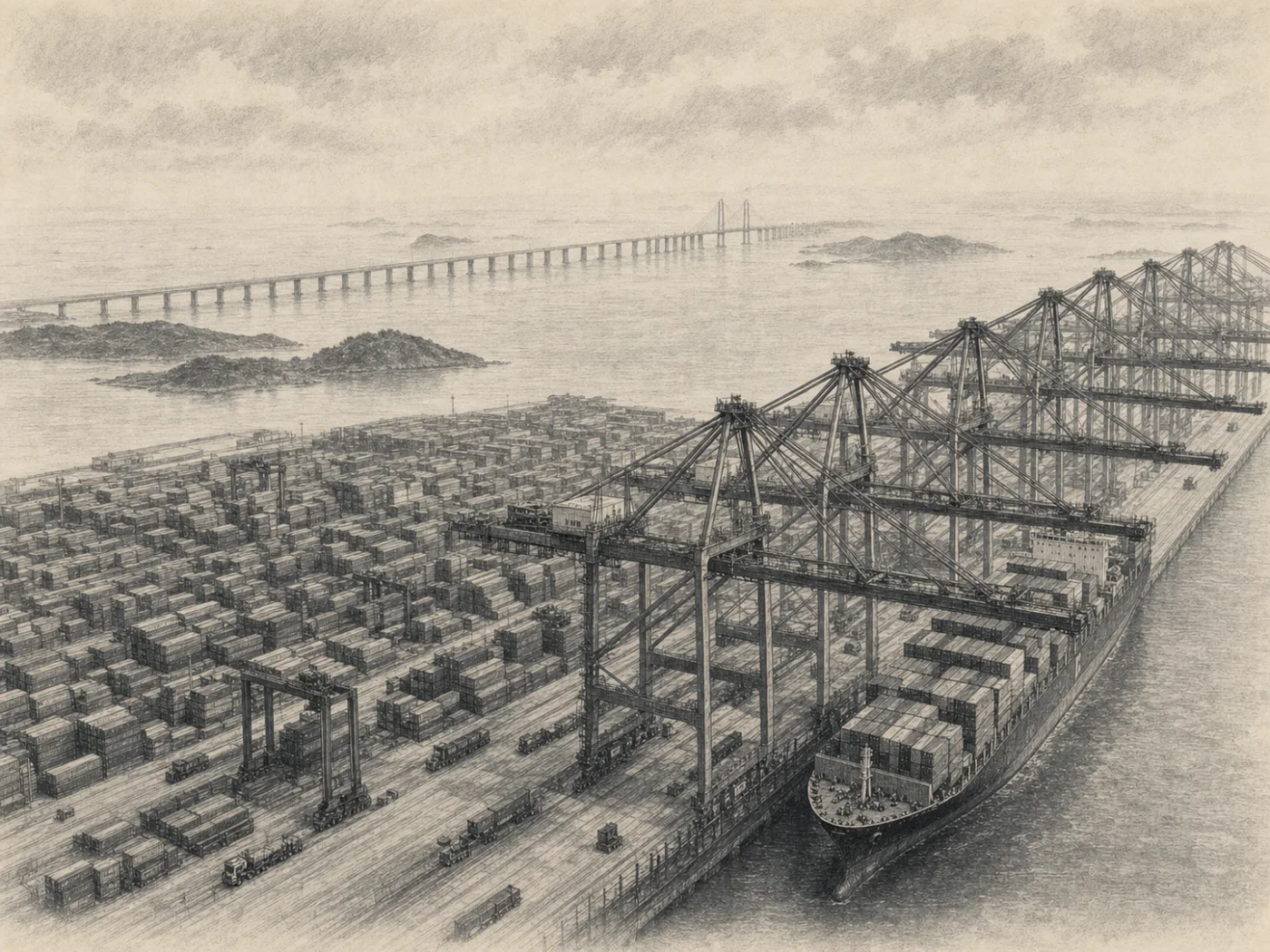
China's trade counter-strategy is hardening into policy infrastructure while Washington's tariff threat remains unresolved. The most concrete new instrument is the MOFCOM-led nine-department opinion on high-quality aviation bonded maintenance 1, which lifts the regional restriction on bonded repair business (no longer limited by area), encourages maintenance enterprises to locate in comprehensive bonded zones, and grants export tax rebates for repair services. It also clears the tax path for repaired aircraft parts to be sold domestically after import duty. This turns China's existing comprehensive-bonded-zone network (Xiong'an, Guiyang, Hainan) into an MRO platform for global aviation, a services-export layer on top of goods trade.
Hainan is being positioned as the spearhead. Party Secretary Feng Fei's inspection of Haikou Customs on 27 August stressed building the free trade port into a customs-supervision special zone with international competitiveness, with "zero tariff" and the processing value-added domestic-sale tariff exemption as the core policies 2. The province is also working the diplomatic lane: Governor Liu Xiaoming met Maldives' trade minister and proposed cooperation in trade, tourism, agriculture, blue economy, digital economy, green energy and low-altitude economy 3; a Hainan-Thai Chinese business dialogue promoted the FTP to Thai Chinese investors 4. These are small but deliberate expansions into Indian Ocean and Southeast Asian markets.
The Macau-Hengqin integration delivered its first operational proof. On 26 August, the Macau International Airport Hengqin front-loading cargo station handled its "first order, first flight" — more than 10,000 cross-border e-commerce parcels shipped via a cross-border road-air intermodal model to Malaysia and the Philippines 5. The station, about 13km from Macau airport, is designed for 300,000 tonnes a year, against Macau's current airport cargo capacity of around 100,000 tonnes, and is scheduled for full operation in 2027. Customs integration — a joint smart lock recognized by both Macau and Hengqin customs under a "Guangdong-Macau joint one-stop" lane — is the enabler. This adds a new air-cargo exit to the set of rail and road corridors already built in Guizhou, Xiong'an and Tianjin.
ASEAN diversification is broadening beyond southern hubs. Shandong held a large-scale Shandong-Vietnam Economic and Trade Cooperation and Enterprise Matchmaking Conference in Jinan on 26 August, with the top party secretary of Vietnam's Bac Ninh province attending 6. Bac Ninh is a major industrial and export center; the two sides agreed to deepen cooperation in electronics, semiconductors, technological innovation, transport logistics and agricultural processing under the Belt and Road and the "Two Corridors, One Belt" framework. This is the same pattern as Jiangsu's 36.4% ASEAN trade jump and Hebei's Belt-and-Road share above 65% — the pivot is becoming a broad institutional habit, not a one-off response to tariffs.
The US-side context has become more volatile, not less. The US-Canada tariff war reignited last week: the US 50% tariff on about US$20 billion of Canadian goods took effect on 22 August, Canada will retaliate on 8 September, and Trump has already announced tariffs on all Canadian autos, trucks, parts and steel will rise to 50% on 1 January 2027 7. The report emphasizes that Washington's signatures are "written in pencil," and the invocation of the rarely used Section 338 of the 1930 Tariff Act shows the administration is reaching for older legal tools. The lesson for Beijing is caution: the Bloomberg-reported 7.5% "overcapacity" tariff 8 could follow the same path — sudden, legalistic, and ratcheting. But the Canadian case also demonstrates that aggressive retaliation can lead to a breakdown, which is consistent with Beijing's refusal to bargain under threats.
The limits haven't changed. The new aviation-maintenance opinion is a framework, not a flow of orders; the Hengqin cargo station is only starting; and the Shandong-Vietnam conference produced cooperation statements, not contract values. Meanwhile the US legal machinery — sunset reviews on steel grating, the battery investigation, Entity List revisions — keeps expanding. The bottom line is that China is racing to institutionalize alternative routes before Washington publishes the 7.5% tariff. If it is published, the second half of 2026 will show even sharper rerouting through bonded aviation, Hainan, Macau and ASEAN; if it is not, the infrastructure is still there to lower the cost of every future non-US trade flow.
What changed in this reading
New institutional push in aviation bonded maintenance 1, Hainan FTP consolidation 2, Hengqin-Macau first air-cargo flight 5, and Shandong-Vietnam conference 6 all reinforce the logistics/diversification theme; US-Canada tariff breakdown 7 adds a cautionary signal. The core judgment is unchanged — Washington tariff threat still key — but the weight of evidence shifts toward China's alternative-route institutionalization.
How the evidence changed
Comparing v147 with v148. Band width counts distinct cited documents.
Newly cited 7
- Hainan-Thailand Chinese Businessmen Dialogue and Hainan Free Trade Port Policy Promotion Conference held in Haikou.
- Liu Xiaoming meets with Mohammed, Minister of Economic Development, Transport and Trade of the Maldives.
- 'First Order, First Flight' Lands, Solid Progress Made in Major Project for Hengqin-Macau Integration
- 2026 Shandong-Vietnam Economic and Trade Cooperation and Enterprise Matchmaking Conference held
- Opinions of the Ministry of Commerce and 8 Other Departments on Promoting High-Quality Development of Aviation Bonded Maintenance
- US-Canada tariff war reignites: refusing 'bullying', where does Canada's confidence come from?
- Feng Fei conducts investigation at Haikou Customs.
No longer cited 12
- Certain Secondary Cylindrical Batteries, Components Thereof, and Products Containing the Same; Notice of Institution of Investigation
- Revisions to the Entity List
- In the first 7 months, Hebei Province's total foreign trade import and export value increased by 30.8% year-on-year.
- In the first 7 months, Jiangsu's imports and exports with ASEAN increased by 36.4% year-on-year.
- Implementing the 'Three-Five' plan to empower enterprises to go global to Portuguese- and Spanish-speaking markets; Investment Promotion Bureau held roadshows in Shenzhen and Guangzhou with nearly 300 enterprise representatives.
- Taiwan issues indictments over alleged illegal export of AI servers to China
- In conversation with Wu Yanjing, Zhang Jiajun, and Qiu Hui: Agents begin to count the economic costs.
- Vice Foreign Minister Ma Zhaoxu Meets with Asia Society Co-Chair Thornton and Delegation (2026-08-25)
- Xiong'an New Area's Foreign Trade Surges 6.2-Fold in First Half, Showcasing Opening-Up Vitality
- Steel Grating From China; Scheduling of Expedited Five-Year Reviews
- Guizhou cultural tourism and trade promotion held in Seoul; "Deep in Wumeng" to air in South Korea and Thailand.
- Guizhou's first return China-Laos freight train with 'bonded logistics + fast rail clearance' arrives in Guiyang.
Evidence behind this reading
| # | Document | Publisher | Published |
|---|---|---|---|
| 01 | Opinions of the Ministry of Commerce and 8 Other Departments on Promoting High-Quality Development of Aviation Bonded Maintenance | MOFCOM | · |
| 02 | Feng Fei conducts investigation at Haikou Customs. | Hainan Provincial Government | · |
| 03 | Liu Xiaoming meets with Mohammed, Minister of Economic Development, Transport and Trade of the Maldives. | Hainan Provincial Government | · |
| 04 | Hainan-Thailand Chinese Businessmen Dialogue and Hainan Free Trade Port Policy Promotion Conference held in Haikou. | Hainan Provincial Government | · |
| 05 | 'First Order, First Flight' Lands, Solid Progress Made in Major Project for Hengqin-Macau Integration | Guangdong Provincial Government | · |
| 06 | 2026 Shandong-Vietnam Economic and Trade Cooperation and Enterprise Matchmaking Conference held | Shandong Provincial Government | 2026-08-27 |
| 07 | US-Canada tariff war reignites: refusing 'bullying', where does Canada's confidence come from? | Yicai | 2026-08-26 |
| 08 | US Eyes China Overcapacity Tariffs of 7.5% Before Xi-Trump Talks | Bloomberg | 2026-08-24 |
China Snapshot, a publication of CHINA SNAPSHOT LIMITED (Hong Kong). Operated by Tristan McInnis, Managing Partner, Inner Chapter, Shanghai. Chinese sources machine-translated by DeepSeek; interpretation drafted by a language model under our editorial standards; corrections to support@china-snapshot.com.