
Historical reading · v118 · 2026-09-05. Read the current understanding and full revision history →
Historical reading v118 · 公开专题 · 半导体与芯片
Semiconductors & Chips
China's semiconductor and integrated-circuit industry — chip self-sufficiency, fabrication, lithography, wafers, the Big Fund, and chip supply chains.
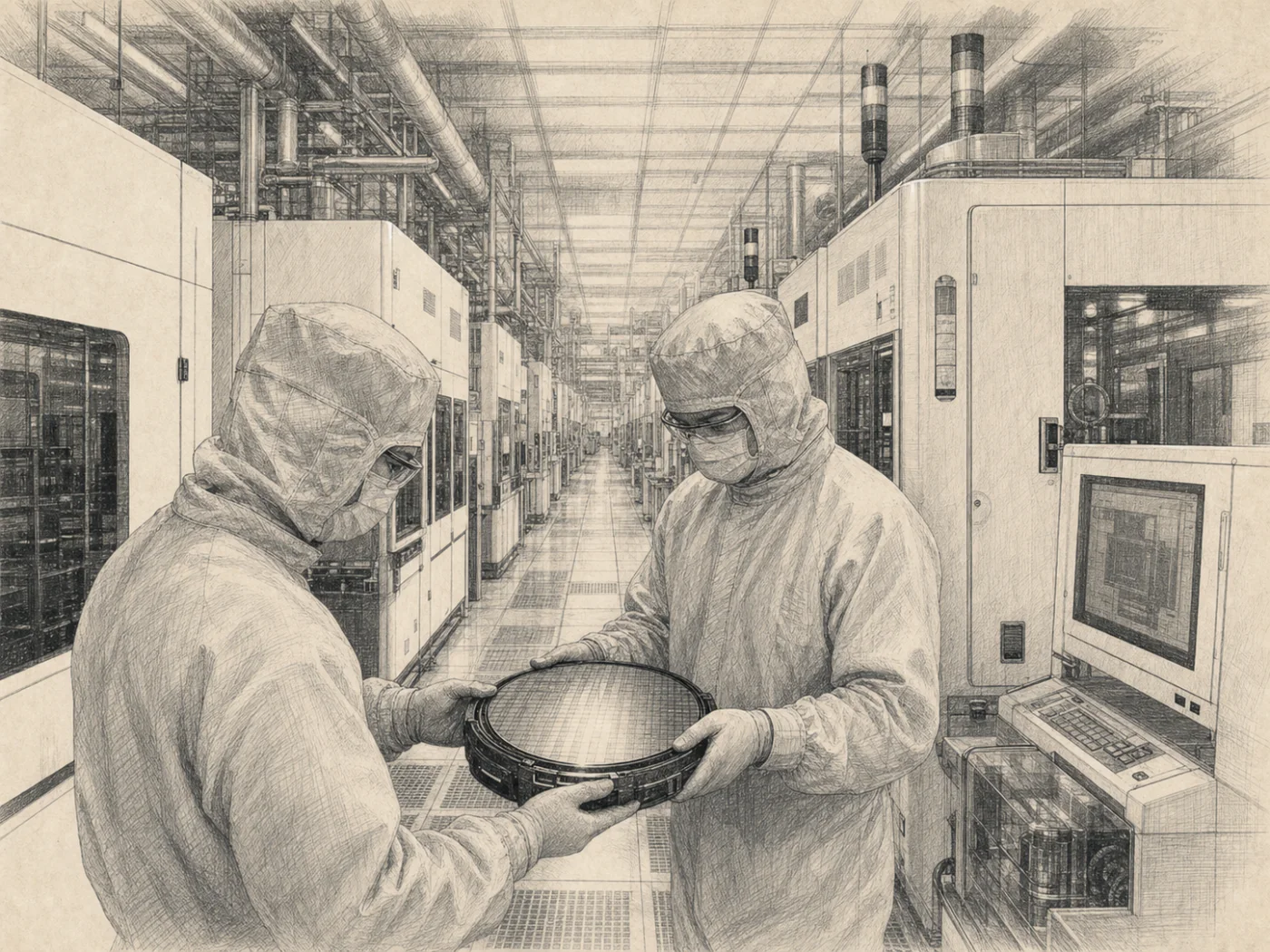
Historical reading v118 · v118 · 5 Sep
Domestic AI-chip shipments hit 41% of China market; frontier constraints hold
China's chip program is still a determined below-frontier build-out, but the demand side is now quantifiably large. In 2025, Chinese suppliers shipped roughly 1.65 million AI accelerator boards in China, taking 41% of a ~4-million-board market, led by Huawei's 812,000 units (20.4%); Nvidia still held 55% 1. Suiyuan Technology's imminent STAR Market listing now has a market-share context: domestic AI-chip design has reached capital-market scale, yet the equipment and advanced-process constraints that define the contest have not moved.
The financial mechanism behind this scaling is clearer in Caixin's tiered inventory of the GPU field. The 'GPU five small tigers' — Moore Threads, MetaX, Biren, Tianshu Zhixin and Suiyuan — sit behind Huawei, Alibaba's T-Head, Baidu's Kunlun and Cambricon; Kunlun has confidentially filed for a Hong Kong IPO, and Suiyuan is set to land on the STAR board this month 1. Suiyuan's case remains the cleanest indicator of how the system works: Tencent is both anchor shareholder (20.26%) and anchor customer, so public capital is being used to scale a captive-cloud AI chip business rather than to challenge Nvidia head-on 2.
A parallel signal arrives from memory markets. Mainstream PC DRAM (DDR4 8Gb) averaged $25 per contract unit in August, a record high, with NAND also elevated; Xiaomi, Huawei and Honor have responded by raising flagship phone prices by up to 1,000 yuan 3. The memory price boom is AI-driven and supply-disciplined, and for Chinese DRAM producers it is a mixed blessing: higher prices support margins and strengthen the economic case for local substitution, but the tooling constraint that blocks leading-edge DRAM remains exactly where it was.
No central-level industrial-policy document appears in this batch. The main state-to-state, semiconductor-adjacent action is the U.S.-China AI safety dialogue planned for mid-September — the first dedicated to AI in Trump's second term; sources say Washington wants joint monitoring of AI-driven cyberattacks, while Beijing treats the dialogue as a deliverable before the September 24 leaders' summit 4. That is a governance track, not a loosening of chip export controls, and it does not move the equipment bottleneck.
Taiwan continues to define the alternative pole, wrapping the semiconductor ecosystem in diplomatic ceremony. At SEMICON Taiwan 2026, Premier Cho offered land, energy, finance and talent; Vice President Hsiao appeared at a SEMI/TSIA 'technology elite leaders' dinner and presented leadership and industry-contribution awards, including to TSMC's Ho Li-Mei 5,6. The previous day, President Lai awarded economic medals to GlobalWafers' Hsu Hsiu-lan and Micron's Mehrotra at a 38-country chip supply-chain summit, then used the Invest EU Forum to push a Taiwan-EU semiconductor strategic partnership, citing the EU Chips Act 2.0 and TEEMA's planned Poland tech park 7,8. The mainland's counterpart is Shandong's 30th cross-strait fair with a semiconductor-and-smart-manufacturing matching session 9 — a useful but weaker instrument.
The limits remain visible. Nvidia's 55% share shows advanced training cards are still dominant; the 41% domestic figure mixes inference accelerators, edge parts and other AI chips, so it is not a substitute for leading-edge capability. A U.S. International Trade Commission action on foreign-fabricated semiconductor devices was terminated on a joint motion 10; the case is minor, but it is a reminder that legal and trade friction on chips continues. Watch, then, for three things: Suiyuan's post-IPO disclosures on whether demand extends beyond Tencent; the mid-September AI-safety dialogue for any sign that export-control discussions are moving; and the memory price cycle, which is handing Chinese DRAM producers pricing power that could convert into investment if equipment access improves.
What changed in this reading
New Caixin/IDC market data quantifies domestic scaling, putting Chinese suppliers at 41% of China's 2025 AI accelerator shipments, and recasts the vendor field as a 'GPU five small tigers' group that includes Suiyuan; memory-chip contract prices hit record highs, pushing up phone prices. The batch adds no new central chip-policy document; the closest adjacent signal is the planned mid-September US-China AI safety talks. The standing assessment otherwise holds.
How the evidence changed
Comparing v117 with v118. Band width counts distinct cited documents.
Cited in both 5
- President attends semiconductor supply chain summit, hopes international enterprises will deepen roots in Taiwan and let technology become a force for peace and prosperity
- President attends Invest EU Forum, hopes to deepen Taiwan-EU economic, trade and semiconductor strategic partnership, jointly build resilient supply chains
- Provincial Leaders Attend Events of the 30th Shandong-Taiwan Economic and Trade Fair
- Suiyuan Technology opens IPO subscription this week; Tencent is both its largest external shareholder and largest customer
- SEMICON International Semiconductor Expo opens; Premier Cho: Land, energy, finance, and talent support ready, joining hands with the world to create new heights.
Newly cited 5
- Vice President Attends Technology Elite Leaders Dinner, Recognizes Outstanding Contributions of Semiconductor Industry Leaders
- China's AI chips usher in a rising opportunity
- EXCLUSIVE: US, China gear up for mid-September AI safety talks
- Memory Chip Prices Hit Record Highs, New Flagship Phones May Approach 10,000 Yuan
- Certain Foreign-Fabricated Semiconductor Devices, Products Containing the Same, and Components Thereof; Notice of a Commission Determination Not To Review an Initial Determination Granting a Joint Motion To Terminate the Investigation
No longer cited 6
- Blue Owl leads Iren's $2.4 billion debt financing for Nvidia chip purchases
- Provincial Innovation and Entrepreneurship Plan Draws 2,000+ Talents
- Trend key: AI chip power consumption forces cooling upgrades! Liquid cooling server sector strengthens, hundreds of billions market enters payoff period
- 2026 Integrated Circuit (Wuxi) Innovation and Development Conference Opens; Liu Xiaotao Attends
- Net profits up by 580 billion yuan! A-share half-year reports concluded; where did the money come from and where did it go?
- Loss narrows in the period; Zhipu emphasizes revenue mix shift and addresses computing power reserves and industry competition
Evidence behind this reading
China Snapshot, a publication of CHINA SNAPSHOT LIMITED (Hong Kong). Operated by Tristan McInnis, Managing Partner, Inner Chapter, Shanghai. Chinese sources machine-translated by DeepSeek; interpretation drafted by a language model under our editorial standards; corrections to support@china-snapshot.com.