
Historical reading · v111 · 2026-08-31. Read the current understanding and full revision history →
Historical reading v111 · 公开专题 · 半导体与芯片
Semiconductors & Chips
China's semiconductor and integrated-circuit industry — chip self-sufficiency, fabrication, lithography, wafers, the Big Fund, and chip supply chains.
Historical reading v111 · v111 · 31 Aug
Chip self-sufficiency steady; CXMT courts, space-compute funds
China's self-sufficiency drive remains a mature-node and design-heavy buildout below the leading-edge lithography ceiling, but this period adds two genuinely new dynamics: memory maker CXMT is fighting its US blacklisting in federal court 1, and space-computing — a new downstream chip demand — is drawing venture capital, not just government forums 2,3. Neither breaks the lithography constraint, but the picture is no longer just policy-plus-foundry; Chinese firms and private money are now responding to export-control pressure with legal and financial counter-moves.
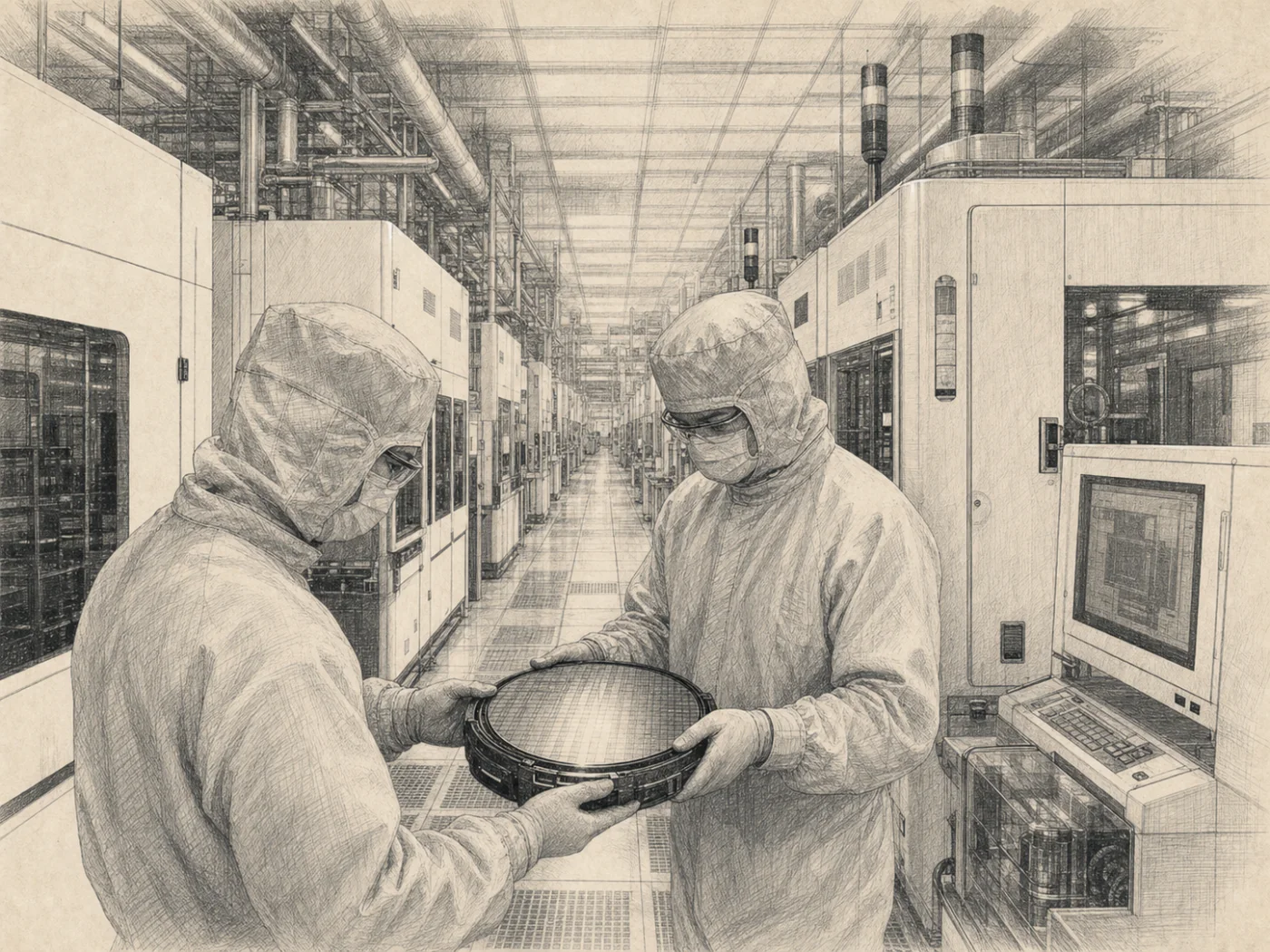
Foundry results keep confirming the mature-node story. SMIC's Q2 sales crossed $3 billion, up 36.1% year on year, with China-region revenue at 90.2% and net profit up 261.7%; Hua Hong posted a record $717.5 million at 102.8% utilization, and both raised Q3 guidance 4. Consumer electronics remains the largest end-market for both — 44.2% for SMIC, 67.1% for Hua Hong — evidence that AI demand is inflating mature fabs as much as it is advancing leading-edge logic.
Design localization continues but still depends on external foundries for leading-edge die. Xiaomi's Xuanjie lineup now spans phones, AI, and autonomous driving: the O3 SoC (3nm, 24 billion transistors, 133 mm²) ships in September with the Xiaomi 18 Fold, using CXMT's LPDDR6 — the first flagship to do so; O100 and D100 have passed tape-out verification and go commercial next year 5. Mochu Integrated Circuit's Series B, with Lenovo Capital and Guangzhou government funds, shows private-design capital still flowing 6.
The most concrete new signal is CXMT's lawsuit. On August 28, CXMT sued the US Department of Defense in the DC federal court, demanding removal from its blacklist, arguing its chips are civil/commercial, not military 1. This is a rare, direct corporate counter to US designation pressure and, notably, comes from the same company supplying LPDDR6 to Xiaomi's flagship. It may not alter near-term supply, but it establishes a new playbook — Chinese chipmakers can use US courts, not just state policy, to contest restrictions.
Space computing is turning from slogan to financed pipeline. After Songjiang's first industry forum drew aerospace, semiconductor, cloud, and AI circles together 3, 中科密位 (Zhongke Miwei), incubated by USTC and Shanghai Processor Center, closed over 100 million yuan in A1/A2 rounds from Bohua, Matrix Partners, Hillhouse, Baidu Ventures, and others 2. Its fully domestic heterogeneous intelligent computing system targets satellite on-orbit inference and training — a concrete demand pull for radiation-hardened, low-power chips. This is early stage, but the combination of a government-backed forum and private rounds suggests the chain is being built.
The broader environment is unchanged: central policy remains goal-setting, not money or mandates. NDRC's 'two priorities' pipeline and Chongqing's 750-billion-yuan, 193-project central-enterprise package are framed around national strategies but not chip-specific vehicles 7,8. Equipment progress is incremental — Tuojing topped out its Shenyang deposition-tool base, Tianfu's Q2 recovered but its optical-chip bottleneck persists 9. Globally, memory and semi stocks slumped on August 24, with Nvidia down a seventh session 10, even as Blue Owl led a $2.4 billion debt financing for Nvidia GPUs 11 — capital still flows to AI compute while China builds an alternative chain.
Watch three things next: the DC court's handling of CXMT's suit, whether space-computing venture rounds grow into paid satellite contracts, and SMIC's Q3 capex and guidance. The core story — design-plus-foundry-plus-equipment-plus-materials moving at different speeds below an untouched leading-edge ceiling — holds. But with CXMT in court and private capital entering space chips, the 'self-sufficiency' effort is now also a legal and financial contest, not just an industrial one.
What changed in this reading
Prior brief said 'no export-control response' and cited no new Big Fund. New documents add CXMT's federal lawsuit against the US DoD blacklist (1) and a >100M yuan A1/A2 round for space-computing startup 中科密位 (2), plus Songjiang's space-computing forum (3) shows the demand chain forming. Material change is true because the corporate legal response and private space-chip funding were absent before.
How the evidence changed
Comparing v110 with v111. Band width counts distinct cited documents.
Cited in both 9
- Foundry 'Titans' Rivalry: SMIC and Hua Hong See Q2 Profit Surge
- [Company Express] Tianfu Communication's Q2 Profit Clearly Recovers, Upstream Optical Chip Bottleneck Remains to Be Solved
- Xiaomi unveils three in-house chips; Zhu Dan challenges rivals to 'compete'
- Memory chip stocks slump again, Nasdaq closes lower for seventh session! Spot gold breaks above $4,670.
- Mochu Integrated Circuit has completed a Series B financing of hundreds of millions of yuan.
- One Symposium, Three Lists: Central Enterprises and Chongqing Deepen Cooperation to Unveil a New Picture
- Blue Owl leads Iren's $2.4 billion debt financing for Nvidia chip purchases
- China unveils plan to expedite major projects
- The space computing industry chain is 'complete' in Songjiang; aerospace, semiconductor, cloud computing, and AI industry circles gather at the first industry development forum.
Newly cited 2
- 36Kr Exclusive | USTC team's space intelligent computing platform secures over 100 million yuan in financing, with Bohua, Matrix Partners, Hillhouse and others jointly investing
- Tech Morning Post | AI companies funnel nearly $40 of every $100 earned to cloud giants; Huawei Mate XT 2 Extraordinary Master to be released soon
No longer cited 1
Evidence behind this reading
China Snapshot, a publication of CHINA SNAPSHOT LIMITED (Hong Kong). Operated by Tristan McInnis, Managing Partner, Inner Chapter, Shanghai. Chinese sources machine-translated by DeepSeek; interpretation drafted by a language model under our editorial standards; corrections to support@china-snapshot.com.