
Historical reading · v160 · 2026-09-11. Read the current understanding and full revision history →
Historical reading v160 · 公开专题 · 平台经济与数据监管
Platform Economy & Data Regulation
The platform economy and its regulation — anti-monopoly, internet platforms, data security, cybersecurity, and personal-information protection.
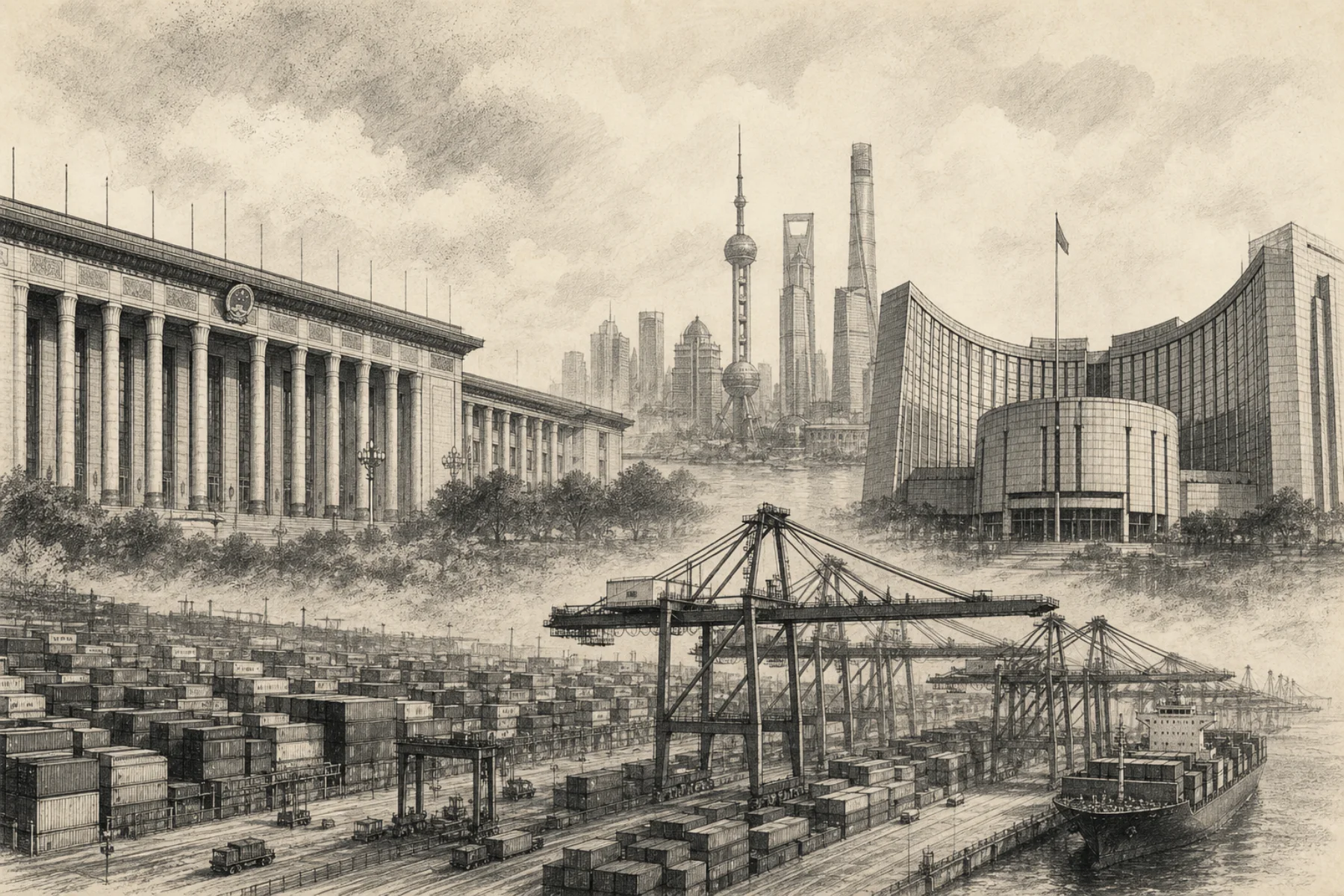
Historical reading v160 · v160 · 11 Sep
Platform rules stay standards-led; China exports anti-fraud governance, no crackdown
China's platform-economy regulation remains in a phase of managed normalization, and nothing in this document set changes that. There is still no SAMR anti-monopoly decision, no CAC enforcement action under the Personal Information Protection Law or Data Security Law, and no State Council platform directive. The only genuinely new regulatory artifact points outward rather than inward: on 10 September 2026 State Councilor and Public Security Minister Wang Xiaohong used the inaugural conference of the International Alliance Combating Telecom and Cyber Fraud in Lianyungang to pledge that China would help turn the body into a global anti-fraud platform and "inject new impetus into improving global public security governance" 1. Beijing's preferred cyber-governance register is multilateral cooperation and public-security framing, not domestic punishment of platforms.
The most concrete domestic instrument to watch is unchanged. CAC's 3 September notice rotates the National Cybersecurity Standardization Technical Committee (SAC/TC260) and opens solicitation for fourth-term members (网安字〔2026〕17号), explicitly keeping eligibility open to representatives of well-known domestic and foreign-invested enterprises active in cybersecurity, information and communications technology, internet media, data security and AI 2. The binding constraints that will shape platform compliance for years—data localization, security-assessment thresholds, AI and content standards—are drafted inside this committee and its working groups. Its fourth-term roster is therefore the clearest single test of whether standard-setting stays genuinely collaborative with industry or narrows to state bodies.
That standards-led model is being reinforced at the plan level. MIIT's development plan for the information and communications industry during the 15th Five-Year Plan (2026–2030) targets a technologically advanced, secure and controllable industrial system and an "agile and efficient governance system integrating technology and management" by 2030 3. This is industrial policy, not punitive policy, and it confirms the state's preferred control method: embedding rules in standards and technical governance rather than in antitrust or data-enforcement cases.
The diplomatic layer runs the same way, and the anti-fraud alliance is its newest expression. At the 9 September MFA press conference, spokesperson Mao Ning rejected US Cybersecurity and Infrastructure Security Agency allegations that DeepSeek and Moonshot AI stole American foundation-model technology, calling Chinese AI the product of high-level self-reliance and open cooperation; asked about US firm Calif's reported AI tool that could take over WeChat accounts, she said only that AI must be steered toward good and abuse prevented 4. Together with the Lianyungang alliance, the picture is of a state shielding domestic champions and projecting cooperation abroad, which reinforces the development-and-security frame rather than signaling a domestic crackdown 4,1.
The counter-signal to monitor is enforcement, and this set offers a second, softer caution against a crackdown reading. Because SAMR and CAC publish penalties through their own channels, the absence of cases in provincial and promotional sources proves little by itself. But provincial messaging continues to tilt pro-business: Gansu People's Congress Vice Chairman Dai Chao, on a September inspection in Tianshui and Longnan, urged a "stable, fair, transparent and predictable legal environment" that removes enterprises' worries and calls for reducing government intervention 5—the language of market normalization, not campaign-style rectification.
Commercial and provincial channels keep pointing the same direction. Meituan's viral cross-border delivery story—a rider buying curry puffs in Singapore for a customer in China—drew curiosity, not compliance friction 6. Haikan Shares launched its AIGC film-and-TV creation platform for the micro-drama and animation track, stressing that AIGC remains a small share of revenue 7. Liaoning's 2026 Global Industrial Internet Conference, themed "智改数转AI兴工" (smart transformation, digital transition, AI empowering industry), again showcased MIIT Vice Minister Xie Yuansheng and firms including China Mobile, China Telecom and Huawei, and touted 1,312 basic or advanced-level smart factories 8,9. Forward-looking industrial stories of this kind are not platform-conduct signals.
The sharper tests remain the published fourth-term TC260 member list and any fourth-quarter penalty announcements from SAMR or CAC. Two longer-range risks are worth tracking: sustained US accusations over AI-model theft could eventually produce a defensive tightening of cross-border data and model-transfer rules, and the new anti-fraud alliance could harden into binding cross-border data-sharing obligations. Neither is supported by this document set yet. Until a test breaks, outside readers should discount "new crackdown" narratives and plan for incremental compliance costs from standards, not for a renewed campaign against private platforms.
What changed in this reading
Added a new outward-facing cyber-governance item: China's launch of the International Alliance Combating Telecom and Cyber Fraud in Lianyungang on 10 September, framed as global public-security cooperation 1. Provincial messaging also picked up a pro-business, normalizing tone, with a Gansu official urging a stable, predictable legal environment and less government intervention 5. No new enforcement, antitrust case or platform directive appeared, so the standing assessment holds.
How the evidence changed
Comparing v159 with v160. Band width counts distinct cited documents.
Cited in both 7
- Notice on the Rotation of the National Cybersecurity Standardization Technical Committee and Solicitation of Members
- Chinese food delivery platform sparks buzz after rider’s Singapore curry puff run
- Haikan Shares: 'Haikan Jingling AI Film & TV Creation Platform' Launched, AIGC Business Accounts for a Small Share of Revenue
- China releases 5-year development plan for information, communications sector
- Foreign Ministry Spokesperson Mao Ning Holds Regular Press Conference on September 9, 2026
- 2026 Global Industrial Internet Conference Opens in Shenyang; Xu Kunlin Attends, Wang Xinwei Delivers Speech, Zhou Bo Attends
- Xu Kunlin and Wang Xinwei met with guest representatives attending the 2026 Global Industrial Internet Conference
Newly cited 2
No longer cited 1
Evidence behind this reading
China Snapshot, a publication of CHINA SNAPSHOT LIMITED (Hong Kong). Operated by Tristan McInnis, Managing Partner, Inner Chapter, Shanghai. Chinese sources machine-translated by DeepSeek; interpretation drafted by a language model under our editorial standards; corrections to support@china-snapshot.com.