
Historical reading · v227 · 2026-10-15. Read the current understanding and full revision history →
Historical reading v227 · 公开专题 · 货币政策与人民币
Monetary Policy & RMB
Monetary policy and the renminbi — PBOC rate moves, RRR cuts, the exchange rate, liquidity, LPR, and cross-border RMB.
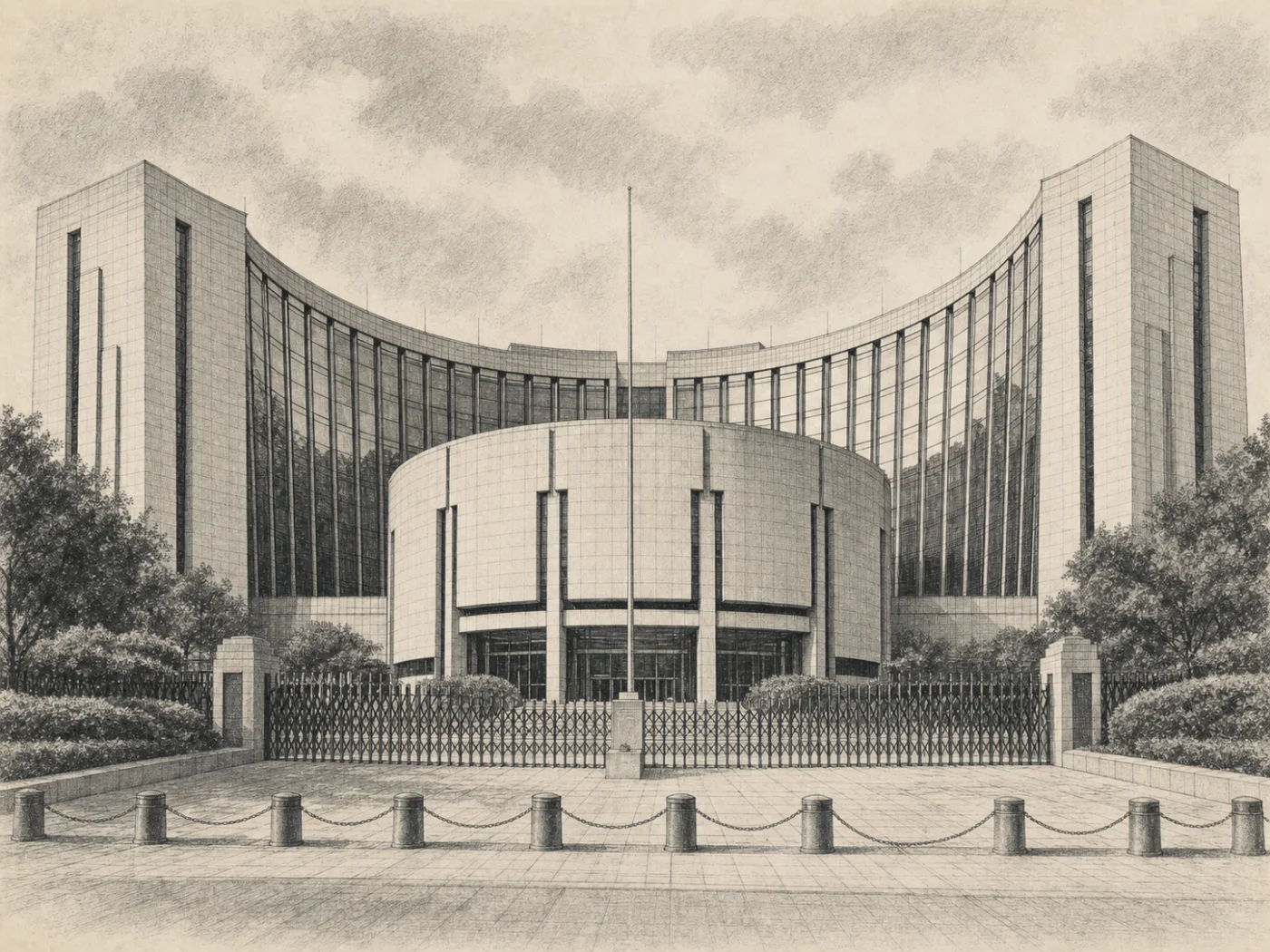
Historical reading v227 · v227 · 15 Oct
PBOC keeps easing bias, hardens FX doctrine at G20
The PBOC restated its easing bias and hardened its exchange-rate doctrine in the same week — without moving a single instrument. At the third G20 finance ministers and central bank governors meeting of the year in Bangkok on October 15, Governor Pan Gongsheng said the PBOC "will continue to implement a moderately loose monetary policy" (适度宽松的货币政策), the clearest stance statement in this batch 1. At the same table he argued that global imbalances "cannot be corrected by exchange-rate adjustment," that currencies are driven by growth, monetary policy, financial markets, geopolitics and shocks and bear no simple linear relation to the current account, and that analysis should weight financial channels and capital flows more heavily. That is a pointed rejection of the revaluation-as-rebalancing case that surplus countries routinely face — and the single most consequential signal here for anyone holding yuan exposure.
The domestic mechanism is unchanged because it is working: ease incrementally, hold the fixing. August's onshore FX market turned over 26.28trn yuan ($3.87trn), with derivatives at 18.62trn yuan — roughly 71% of the total — against spot at 7.66trn yuan 2. A market that deep lets hedging and speculation clear without the central bank spending reserves, which is precisely the condition under which the PBOC can leave rates and reserve requirements untouched. Note that the G20 doctrine cuts both ways: by insisting the exchange rate is not an adjustment tool, Beijing is also reserving the right to manage it.
The flow data back the same read and add a fresh detail. August's balance-of-payments goods-and-services surplus was 640.7bn yuan ($94.4bn), with goods at $116.3bn offset by a $21.8bn services deficit as summer travel lifted the travel line to 173.1bn yuan 3. Bank settlement exceeded sales by about $48.5bn, and client cross-border receipts beat payments by $62.4bn, a net inflow up 4% month on month 4,5. This is earned, not borrowed — and it thins as the travel season ends.
The counter-signal has not improved. The corporate FX settlement ratio was 61.5% in August, 2.7 percentage points below the January-July average: firms are converting less of their foreign-currency income and holding more 5. Persistent drift lower would erode the yuan's flow support with no policy decision attached. It sits alongside a first-half capital-and-financial-account deficit of $345.2bn that offsets the $378.0bn current-account surplus 6 — earned inflows recycled outward, which is the real constraint on any internationalization story.
Internationalization advanced through institutions again. Pan chaired the fourth China-GCC central bank governors' meeting in Bangkok on October 14, meeting the UAE's Khaled, Qatar's Bandar and Oman's Ahmed and Finance Minister Sultan, and renewing the bilateral local-currency swap with Qatar; the agenda covered local-currency cooperation, cross-border payments and financial-market infrastructure 7. The honest gauge of whether this is more than plumbing is the currency composition of external debt: local-currency liabilities were 95,609bn yuan ($1,403.8bn), 56% of the $2,498.2bn total at end-June, with short-term debt at 59% and central-bank debt only 4% 8. That share, not the meeting count, measures depth — and it is holding, not surging.
Implications for external readers and their agents: nothing here justifies repricing yuan exposure off a policy surprise. Base case: incremental liquidity support, a firm grip on the fixing, refusal to let external adjustment arguments drive the currency, and quiet renminbi internationalization through central-bank networks and local-currency debt. Watch three things: September's corporate settlement ratio; the next external-debt release for whether the renminbi share above 56% keeps climbing; and whether the Qatar swap renewal is followed by disclosed scale or drawn use. None of those requires a rate move to matter.
What changed in this reading
Added the PBOC's sharpest exchange-rate doctrine of the year: at the October 15 G20 meeting Pan Gongsheng said global imbalances cannot be corrected by exchange-rate adjustment and called for more weight on capital flows, alongside an explicit pledge to keep a "moderately loose" monetary policy 1. New August goods-and-services surplus of $94.4bn 3 and the full end-June external-debt breakdown confirming local-currency debt at 56% 8. The easing-behind-a-managed-yuan judgment otherwise holds.
How the evidence changed
Comparing v226 with v227. Band width counts distinct cited documents.
Cited in both 6
- SAFE Deputy Administrator and Spokesperson Li Bin Answers Questions from Reporters on the Foreign Exchange Market Situation in August 2026
- SAFE Releases Data on Bank Settlement and Sales of Foreign Exchange and Cross-Border Receipts and Payments for Clients in August 2026
- State Administration of Foreign Exchange releases data on China's foreign exchange market transactions in August 2026
- SAFE Releases China's Full-Scale External Debt Data at End-June 2026
- SAFE Releases China's Balance of Payments for the Second Quarter and First Half of 2026
- Governor Pan Gongsheng attends the Fourth China-GCC Central Bank Governors' Meeting and holds a series of bilateral meetings
Newly cited 2
Evidence behind this reading
China Snapshot, a publication of CHINA SNAPSHOT LIMITED (Hong Kong). Operated by Tristan McInnis, Managing Partner, Inner Chapter, Shanghai. Chinese sources machine-translated by DeepSeek; interpretation drafted by a language model under our editorial standards; corrections to support@china-snapshot.com.