
Historical reading · v220 · 2026-09-14. Read the current understanding and full revision history →
Historical reading v220 · 公开专题 · 货币政策与人民币
Monetary Policy & RMB
Monetary policy and the renminbi — PBOC rate moves, RRR cuts, the exchange rate, liquidity, LPR, and cross-border RMB.
Historical reading v220 · v220 · 14 Sep
No PBOC action; managed easing behind a firm yuan holds
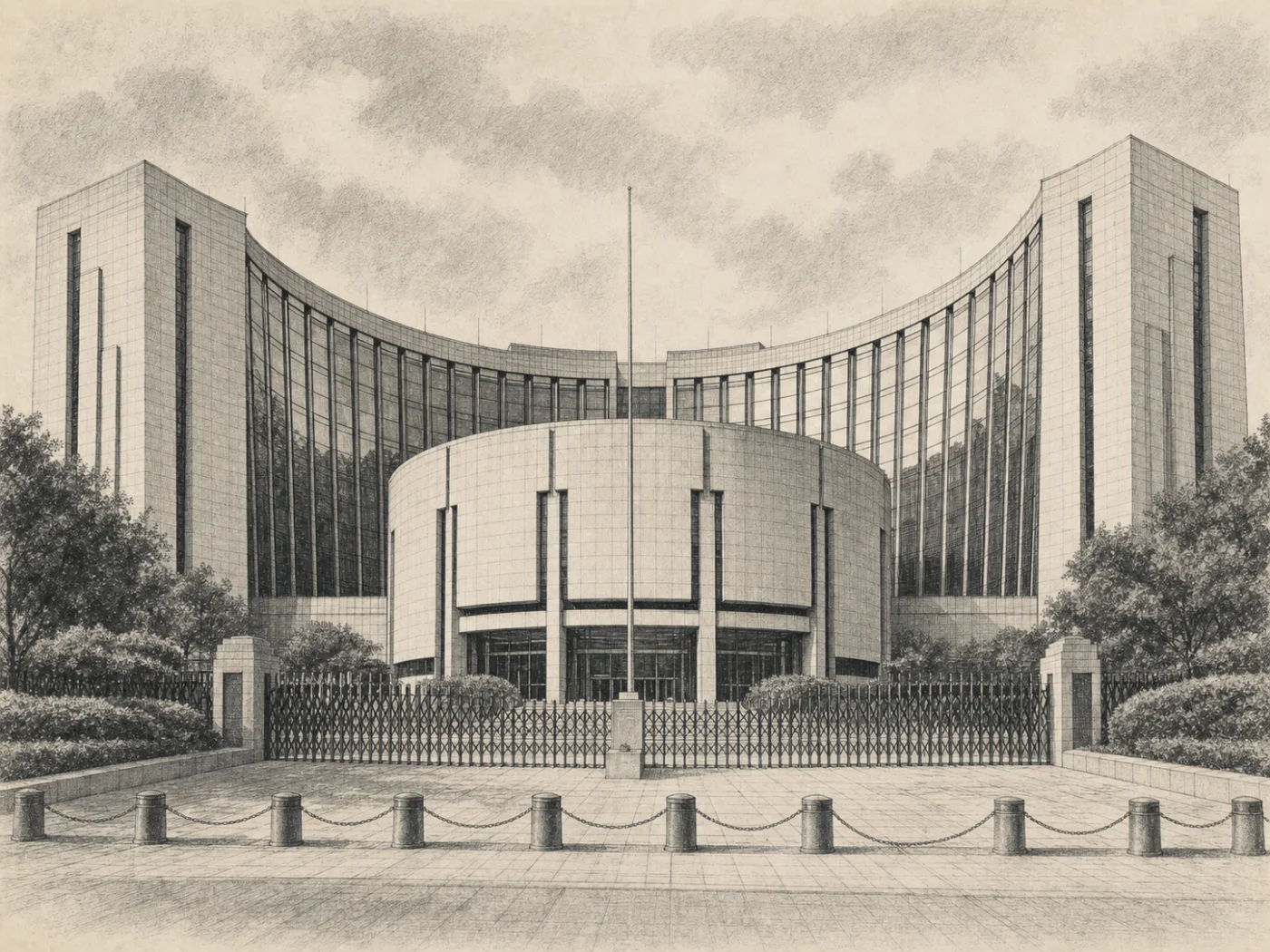
No operational monetary action appears in this batch: no PBOC policy-rate change, RRR cut, LPR adjustment, fixing shift or new liquidity operation. The standing judgment — managed easing behind a managed renminbi, with the PBOC protecting stability as much as growth — holds unchanged. The one monetary-adjacent item is institutional, not operational: Deputy Governor Xuan Changneng attended the BIS governors' meeting in Basel on September 6-7, where central bankers discussed supply shocks, fast AI iteration, a volatile external environment and how to communicate policy 1. That agenda is the PBOC's own framing of its constraints, not a signal of imminent action.
The reason the PBOC can stand still is that the fiscal and investment channels keep carrying load. The NDRC recommended 36 projects to private enterprises — transport, logistics, water conservancy and energy — with combined estimated investment of 61.4bn yuan (about $9.06bn) and expected private capital of 15.6bn yuan 2. On the same logic, the Finance Ministry's first capital injections into insurers put 67bn yuan into four groups — China Life 35bn, Sinosure 10bn, China Taiping 7bn, PICC 15bn — plus 3bn for China Re, while ICBC and Agricultural Bank of China drew 70bn and 130bn respectively and the Export-Import Bank of China got 30bn, a 230bn total against the 300bn originally flagged for banks in the Government Work Report 3. Fiscal capital is doing work that rate cuts would otherwise have to do.
The framing envelope is still the 《金融强国建设“十五五”规划》 (Financial Powerhouse Construction 15th Five-Year Plan), drafted under the Central Financial Committee and presented on September 10 by PBOC Deputy Governor Lu Lei, NFRA Deputy Director Cong Lin, CSRC Vice Chairman Li Chao and SAFE spokesman Li Bin on a single State Council Information Office platform 4. That four-agency choreography matters: credit, exchange-rate and capital-market policy will keep arriving as plan implementation, not as standalone surprises.
The cross-border renminbi track continues to advance on the political calendar with no new currency commitments. The second 2026 BRICS finance ministers and central bank governors meeting in Mumbai on September 10 approved a joint statement and saw the New Development Bank adopt its third five-year strategy (2027-2031); Finance Minister Assistant Chang Junhong stayed on multilateralism, development-finance mobilization and a louder emerging-market voice 5, and Xi Jinping attends the 18th BRICS Summit in New Delhi on September 12-13 6. Renminbi internationalization keeps being routed through multilateral institutions such as the NDB rather than announced as bilateral swap expansion.
The limit is unchanged: nothing here constrains policy with a number. No rate, RRR, LPR, fixing or reserve figure appears, so prior hard data still stand, including end-August FX reserves of $3,438.3bn, up $19.5bn on July and attributed to valuation and asset-price effects rather than intervention. The rest of the batch is provincial and industrial texture — Heilongjiang's digital-economy cluster and a China-Russia e-commerce livestream, a Liaoning cross-border procurement fair, an HKSAR innovation speech, a Shanghai charity tally and a US Venezuela-sanctions notice 7,8,9 — none of which touches the monetary stance.
For readers outside China, stop scanning diplomatic readouts and provincial trade stories for the next surprise cut. The measurable stance lives in the monthly LPR fixing, the PBOC's open-market and medium-term lending operations, and SAFE's reserve and cross-border receipts data. Base case remains continuity: incremental liquidity support, a firm grip on the fixing, and renminbi internationalization advanced quietly through institutions like the NDB. The tests to watch are whether the next quarterly monetary-policy report names a quantitative credit, M2 or exchange-rate target, and whether the NDB's 2027-2031 strategy converts into actual local-currency lending.
What changed in this reading
The only genuinely new item is PBOC Deputy Governor Xuan Changneng's attendance at the BIS governors' meeting in Basel on September 6-7, adding institutional texture on supply shocks, AI and policy communication but no policy content 1; the batch also repeats the NDRC 36-project list, the BRICS/NDB items and the Finance Ministry capital injections with fuller figures 2,3. No rate, RRR, LPR, fixing or liquidity action, so the standing assessment carries over unchanged.
How the evidence changed
Comparing v219 with v220. Band width counts distinct cited documents.
Cited in both 5
- Finance Ministry's first capital injection into insurers: 4 firms get 67 billion yuan
- SCIO holds press conference in "Starting the 15th Five-Year Plan" series, briefing on the financial sector's implementation of the 15th Five-Year Plan and efforts to build a financial powerhouse
- Chang Junhong Attends the Second 2026 BRICS Finance Ministers and Central Bank Governors Series of Meetings
- Xi to attend New Delhi summit to boost greater BRICS cooperation
- China's top economic planner invites private investment in 36 projects
Newly cited 4
- Cross-border cooperation and procurement matchmaking meeting for key markets in Northeast Asia and overseas held in Shenyang
- Permanent Secretary for Innovation, Technology and Industry attends Sing Tao Real Estate Development Trends Forum 2026 and delivers keynote speech on 'Unleashing the Strategic Value of the Hetao Area: From Industry Chain to Talent Flow' (Chinese only) (with photo)
- PBOC Deputy Governor Xuan Changneng Attends BIS Governors' Meeting
- Heilongjiang's 100-Billion-Yuan Digital Economy Cluster Rides the Momentum
Evidence behind this reading
China Snapshot, a publication of CHINA SNAPSHOT LIMITED (Hong Kong). Operated by Tristan McInnis, Managing Partner, Inner Chapter, Shanghai. Chinese sources machine-translated by DeepSeek; interpretation drafted by a language model under our editorial standards; corrections to support@china-snapshot.com.