
Historical reading · v200 · 2026-09-02. Read the current understanding and full revision history →
Historical reading v200 · 公开专题 · 货币政策与人民币
Monetary Policy & RMB
Monetary policy and the renminbi — PBOC rate moves, RRR cuts, the exchange rate, liquidity, LPR, and cross-border RMB.
Historical reading v200 · v200 · 2 Sep
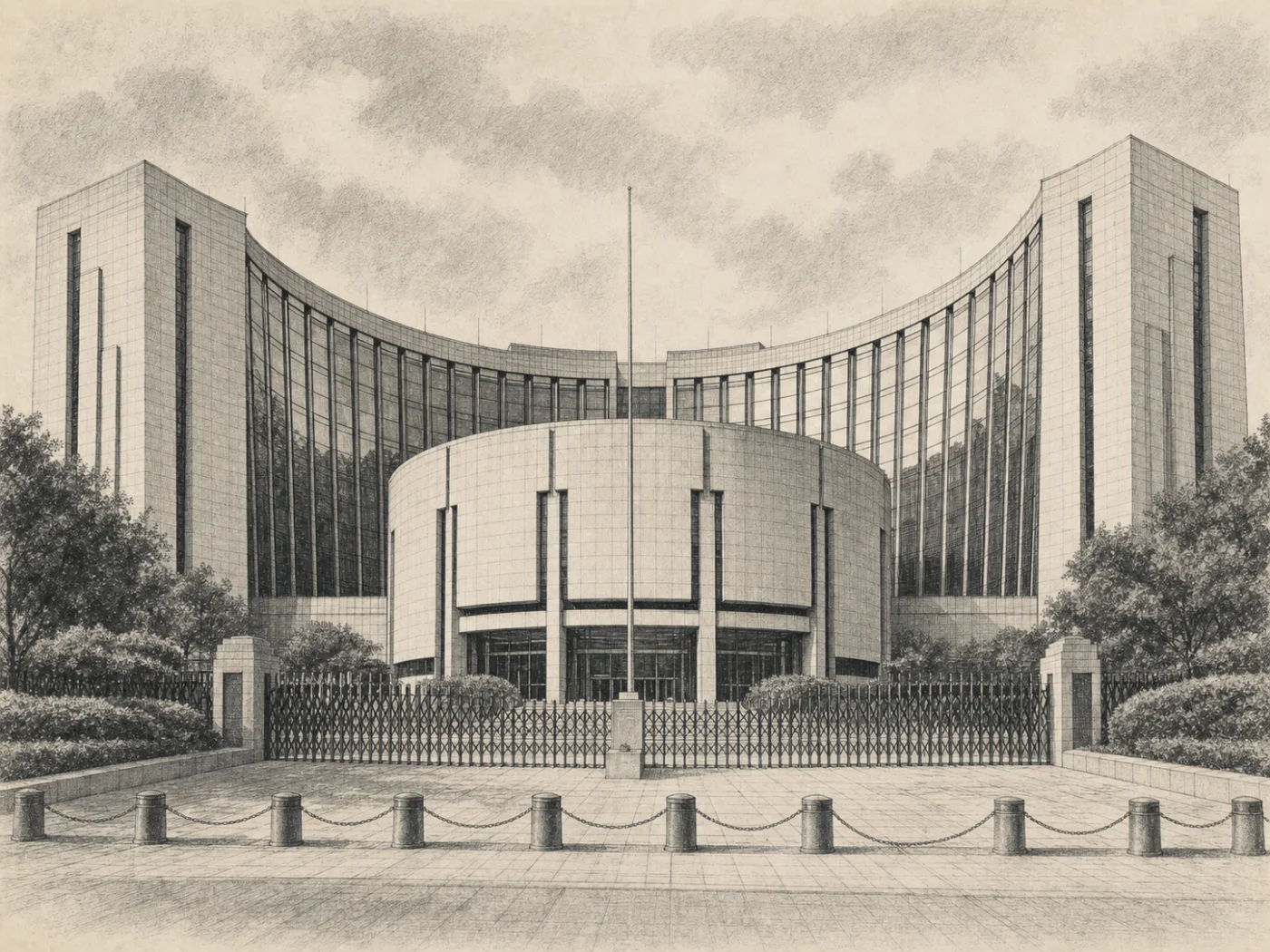
PBOC holds managed easing behind flat fixing; G20 clash intensifies
China's monetary policy remains managed easing behind a managed currency, and the G20 meeting just made the external pressure on that bargain explicit. The PBOC is leaning against the yuan's 20-month rally — fixing flat, turnover falling, year-end USD/CNY forecast at 6.68 — while U.S. Treasury Secretary Scott Bessent is urging G20 partners to consider higher barriers on Chinese goods. For now, expect Beijing to hold the line rather than concede to faster appreciation.
The PBOC's exchange-rate posture is the key mechanism. Reuters market participants report the daily fixing has flattened and turnover is falling, a clear signal that authorities are intervening to support exporters; analysts' median forecast puts year-end USD/CNY at 6.68, implying limited further gains after nearly 9% appreciation over 20 months. This is a deliberate choice: with domestic demand weak, exports remain the economy's bright spot, so the PBOC is prioritizing exporter competitiveness over currency strength 1.
The G20 meeting sharpened the external contradiction. At the Asheville gathering on August 31-September 1, Bessent publicly pushed for higher barriers on Chinese goods, and bilateral talks on the communique stalled over wording on trade imbalances and critical minerals 2. China's delegation, led by Vice Finance Minister Liao Min, pushed back, calling for a "comprehensive, objective and balanced" view of global imbalances and arguing that developing countries' debt should be resolved through development rather than pressure. Liao also held bilateral talks with U.S., Australian, EU, Indian, and other counterparts, reinforcing China's effort to multilateralize the debate 3. This is a direct rebuttal of the U.S. framing, and it signals Beijing will not trade away its exchange-rate policy under G20 pressure.
Domestically, easing continues through targeted structural tools rather than headline rate cuts. The latest concrete channel is the 40-year mortgage term, now implemented by several banks in Shenzhen; a one-million-yuan loan stretched from 30 to 40 years saves roughly 7,000 yuan per year in principal repayment, though some banks cap borrower age plus tenure at 75. One state-owned bank manager said existing 30-year loans can also be converted to 40-year terms 4. This reduces household repayment pressure without forcing the PBOC into a broader easing stance that might accelerate capital outflows or weaken the yuan.
RMB internationalization proceeds alongside the stability-first policy. Shenzhen will issue RMB 1 billion in three-year Greater Bay Area-themed sustainable development offshore RMB bonds in Macau in early September, its second consecutive annual issuance; the Macao Monetary Authority welcomed the move, saying it will encourage more green and sustainable issuers 5. This keeps cross-border RMB channels active even as the onshore exchange rate is managed tightly, and it reinforces Macau's role as an offshore RMB hub.
The export rationale is backed by hard data. Liaoning province's exports rose 12.2% year-on-year to RMB 263.48 billion in January-July, with machinery and electronics up 18.6% to RMB 140.51 billion, 53.3% of total exports, and ship exports surging 178% 6. High-value-added exports are the economy's best-performing segment, which is precisely why the PBOC resists letting the yuan run — an appreciation that prices these goods out of global markets would hurt the one bright spot in an otherwise unbalanced recovery.
The limit of this strategy is that it is exposed to U.S. retaliation. If the final G20 communique includes language explicitly targeting China on imbalances, or if Washington translates Bessent's rhetoric into tariffs, the PBOC's hand could be forced — either to let the yuan appreciate faster (hurting exporters) or to ease more aggressively (risking currency instability). For now, China's G20 pushback suggests the tradeoff will continue to be managed, not resolved.
What changed in this reading
The G20 meeting in Asheville has now occurred, with China's delegation led by Vice Finance Minister Liao Min publicly pushing back against U.S. Treasury Secretary Bessent's calls to raise barriers on Chinese goods, reaffirming the exchange-rate posture. No new PBOC rate, RRR, or fix actions were announced; the prior assessment of managed easing and a managed currency holds, so the material change is limited to confirming the standoff.
How the evidence changed
Comparing v198 with v200. Band width counts distinct cited documents.
Cited in both 4
- High value-added products become main driver of export growth
- China reins in rising yuan as weak domestic demand clouds outlook
- Monetary Authority welcomes Shenzhen Municipal People's Government's issuance of local government bonds in Macau.
- Mortgage term extended to 40 years; borrowing 1 million yuan saves 7,000 yuan per year. Multiple banks have implemented it; some banks say full term requires age under 35 | Investigation.
Newly cited 2
No longer cited 1
Evidence behind this reading
| # | Document | Publisher | Published |
|---|---|---|---|
| 01 | China reins in rising yuan as weak domestic demand clouds outlook | Reuters | 2026-08-31 |
| 02 | US urges G20 to cut trade imbalances, focus on China | Reuters | 2026-09-01 |
| 03 | Liao Min Attends the Second G20 Finance Ministers and Central Bank Governors Meeting in 2026 | MOF | 2026-09-02 |
| 04 | Mortgage term extended to 40 years; borrowing 1 million yuan saves 7,000 yuan per year. Multiple banks have implemented it; some banks say full term requires age under 35 | Investigation. | Yicai | 2026-08-31 |
| 05 | Monetary Authority welcomes Shenzhen Municipal People's Government's issuance of local government bonds in Macau. | Macao SAR Government press | 2026-09-01 |
| 06 | High value-added products become main driver of export growth | Liaoning Provincial Government | · |
China Snapshot, a publication of CHINA SNAPSHOT LIMITED (Hong Kong). Operated by Tristan McInnis, Managing Partner, Inner Chapter, Shanghai. Chinese sources machine-translated by DeepSeek; interpretation drafted by a language model under our editorial standards; corrections to support@china-snapshot.com.