
Historical reading · v176 · 2026-08-27. Read the current understanding and full revision history →
Historical reading v176 · 公开专题 · 货币政策与人民币
Monetary Policy & RMB
Monetary policy and the renminbi — PBOC rate moves, RRR cuts, the exchange rate, liquidity, LPR, and cross-border RMB.
Historical reading v176 · v176 · 27 Aug
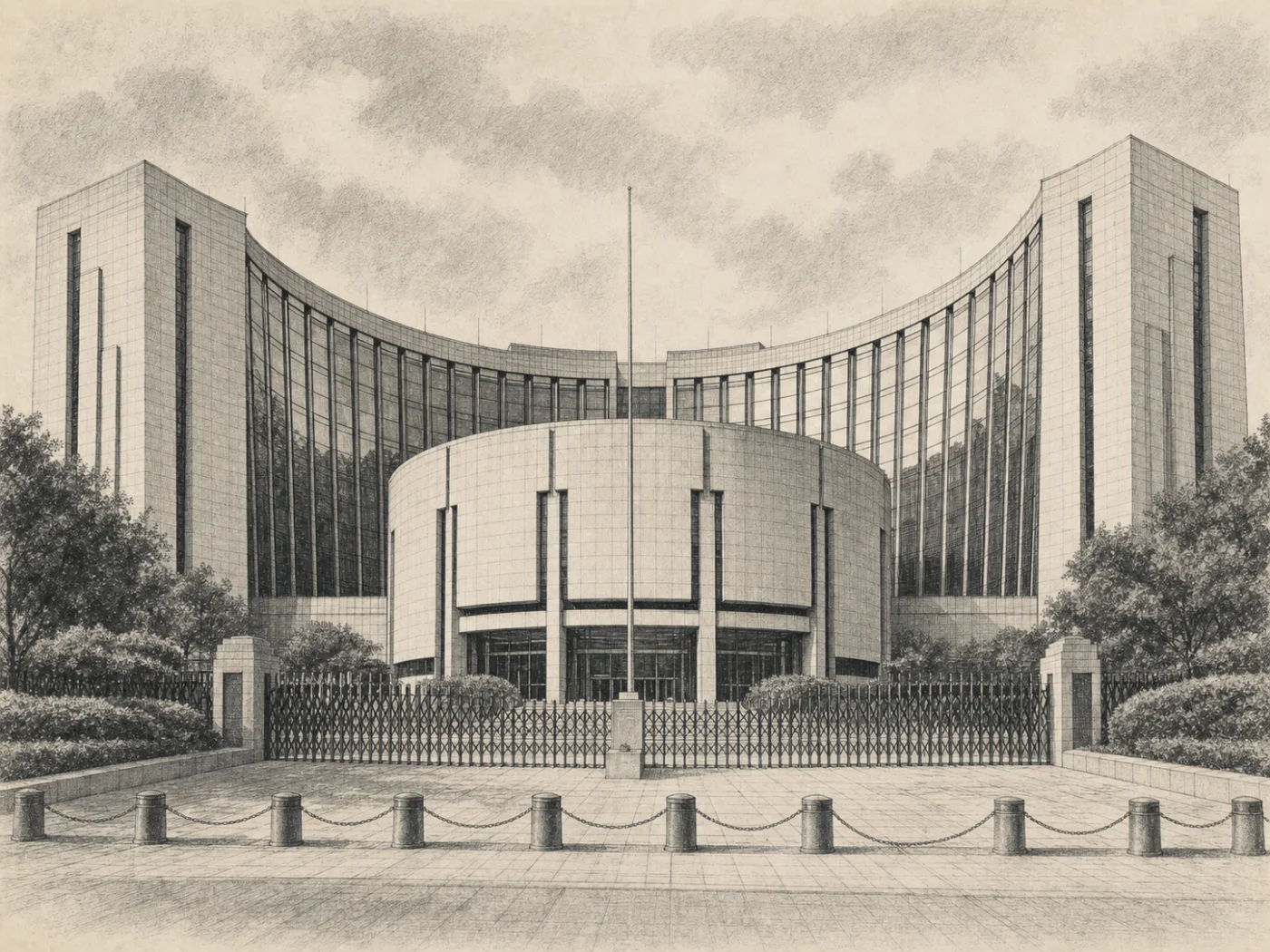
Easing bias intact; PBOC defends yuan via CNH tender
China's monetary policy is now officially easing-biased, and the yuan is being defended only tactically within that stance. The State Council's mid-year plan implementation report, delivered by NDRC deputy head Wang Changlin to the NPC Standing Committee on 25 August, directs "a more proactive fiscal policy and a moderately loose monetary policy" (适度宽松的货币政策) and calls for stronger counter-cyclical adjustment with timely incremental policies 1. This is the authoritative H2 2026 policy signal: the default question has shifted from whether the PBOC will ease to when and by how much.
The macro case for action is explicit in the same report. H1 GDP grew 4.7% year on year, adding RMB 3.6 trillion — the strongest H1 increment in five years — while price pressures remain muted 2,1. With inflation below target, the "moderately loose" language creates room for an LPR cut or another RRR reduction in the coming weeks. The first concrete test is the 20 September LPR fixing; a targeted RRR cut or larger MLF/open-market injections could come earlier.
Yet the PBOC has not abandoned the yuan. The 25 August offshore RMB central bank bill tender in Hong Kong — the main tool for tightening offshore (CNH) liquidity — was heavily oversubscribed: a RMB 15 billion three-month tranche drew RMB 39.95 billion of bids (bid-to-cover about 2.7) at an average accepted yield of 1.26%, with a one-year tranche also tendered 3. This is consistent with the standing read: Beijing is willing to drain CNH cash to discourage one-way depreciation bets, but treats this as a tactical instrument inside an explicitly supportive policy stance.
Asset-allocation data continue to support the easing channel. Total asset management reached RMB 191.71 trillion at end-H1, up RMB 7.18 trillion in six months; within mutual funds, bond funds rose 10.76% and mixed funds 27.32% while equity funds fell 16.85% 4. Bank wealth-management products still anchor the system at RMB 33.66 trillion, with fixed-income products at 96.49% of the mix, so the marginal yuan is overwhelmingly flowing into instruments that gain from lower rates 4. That flattens yield curves and improves the pass-through of future cuts, making PBOC easing more effective once delivered.
The limits are real. "Moderately loose" is not full-blooded easing: the official formulation pairs it with "more proactive fiscal policy" and stresses unleashing the effectiveness of existing stock policies before planning incremental measures (增量政策) 1. The wording does not commit to a specific instrument or timetable. That leaves room for gradualism — a small LPR cut or a targeted RRR move rather than a large across-the-board injection, especially while the yuan faces depreciation pressure. The absence of any new operational easing in this document batch is a reminder that the bias is forward guidance, not yet action.
For outside readers, watch three markers: the next LPR fixing on 20 September, any RRR announcement or MLF operation before then, and daily central parity fixings for tolerance of yuan depreciation. RMB internationalization continues on a separate track, but none of the latest documents substantively changed that picture. The standing assessment stands: easing is coming, but it will be managed so as not to break the yuan.
What changed in this reading
No material change. The new batch re-circulates the same anchor documents already in the standing brief — the NDRC implementation report 1, the PBOC offshore bill tender results 3, and the asset-management scale data 4 — and the remaining documents (Chongqing private economy, Macau-Hengqin cargo, disaster response, Taiwan fraud) are off-topic. The easing-bias-plus-yuan-defense assessment is confirmed, not revised.
How the evidence changed
Comparing v175 with v176. Band width counts distinct cited documents.
Cited in both 4
- Tender Results of RMB Central Bank Bills on August 25, 2026
- Net increase of over 7 trillion yuan in half a year! Big asset management scale hits 191 trillion, where is the money flowing?
- China striving to ensure good start to 15th Five-Year Plan period: official
- Striving for a Strong Start to the 15th Five-Year Plan: Key Economic Priorities for H2 from the Plan Implementation Report
Newly cited 0
No longer cited 0
Evidence behind this reading
| # | Document | Publisher | Published |
|---|---|---|---|
| 01 | Striving for a Strong Start to the 15th Five-Year Plan: Key Economic Priorities for H2 from the Plan Implementation Report | NDRC | 2026-08-26 |
| 02 | China striving to ensure good start to 15th Five-Year Plan period: official | State Council (EN) | · |
| 03 | Tender Results of RMB Central Bank Bills on August 25, 2026 | HKSAR Government press releases | 2026-08-25 |
| 04 | Net increase of over 7 trillion yuan in half a year! Big asset management scale hits 191 trillion, where is the money flowing? | 21st Century Business Herald | 2026-08-25 |
China Snapshot, a publication of CHINA SNAPSHOT LIMITED (Hong Kong). Operated by Tristan McInnis, Managing Partner, Inner Chapter, Shanghai. Chinese sources machine-translated by DeepSeek; interpretation drafted by a language model under our editorial standards; corrections to support@china-snapshot.com.